An Interview with Jack Leek, Part Two
June 22, 2026 - 2:27pm
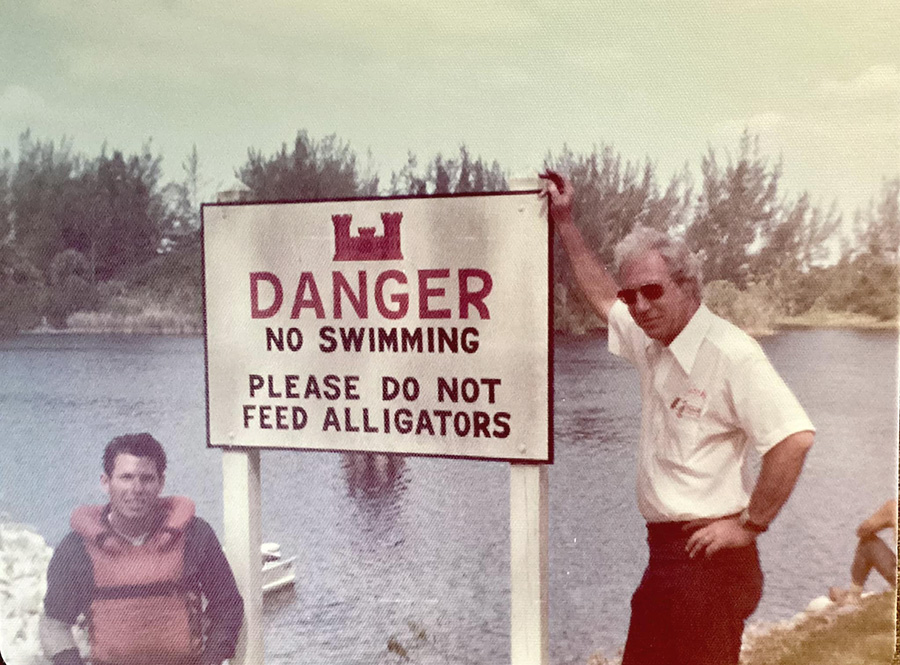
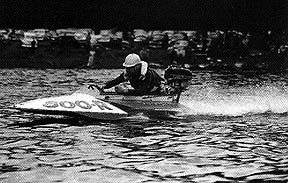
Sometimes testing was more dangerous in Stuart, Florida than actual racing! Jimbo McConnell and Jack Leek…and the alligators! Early 1970s. Photo courtesy of Cathy McConnell
By Craig Fjarlie
Last month, in part one of the interview with Jack Leek, he discussed his early involvement with outboard racing, participation in various classes, working in the marine industry, and his friendship with Hugh Entrop who was pursuing outboard speed records. In part two of the interview, Leek remembers a number of people he knew in racing and offers his thoughts about the status of power boat racing.
(Fjarlie) After Entrop changed loyalties, you worked with Burt Ross on a straightaway project.
(Leek) Well, let’s back up a little further. After Hugh set the straightaway record in 1958, I was kind of tired of the retail business. We had another man who was doing the repair business at Narrows Marine anyway. I’d been kind of on a leave of absence, so I gave ‘em my notice. I went on a retainer with Kiekhaefer, responsible directly to Kiekhaefer and Charlie Strang. Hugh wouldn’t go on this retainer. That’s when he defected, during that period, and set the 113 (MPH record speed) down at Havasu.
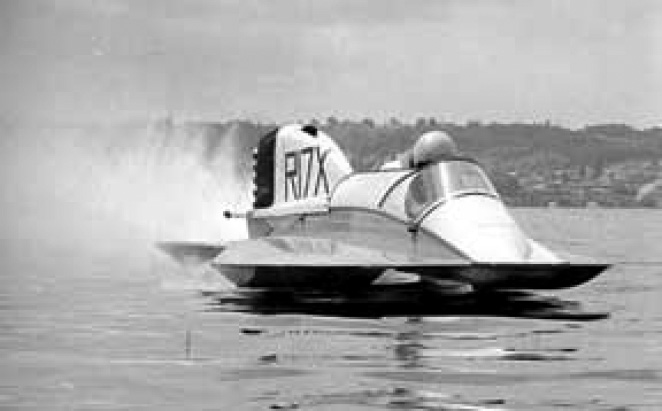
Jack Leek’s expertise helped Burt Ross achieve a record of115.507 MPH.
That was with Starflight Too.
So, then Kiekhaefer insisted we set up the straightaway again and get somebody to drive it, if I didn’t want to drive it. Well, I didn’t want to drive it. Burt worked for a distributor, Pacific Marine, at the time as a salesman. I talked to Bob Ladd, who was the head of Pacific Marine at the time, and he agreed to loan us Burt for that purpose. So, Burt was the driver. Ron (Jones) built the boat and I rigged it when Charlie shipped the engine out to us.
That was a Mark 75H?
Yeah, much like the one Entrop had run except this one was apparently hand-worked by one of the top engineers in the research department.
Did you see the inside?
No, I really didn’t. They told me the horsepower figure at the time, and I know it was just slightly over 100 horsepower, where I think Entrop’s had been more like 75 or 80. In any event, in our testing we were having wind troubles and delays, and Carl was going nuts. Carl was trying to sell the factory at that point, too. He was using his time here to kind of hide out and not get involved in all the politics back there.
So, Burt did all his testing on the east channel of Lake Washington?
No, not at all. Carl got so frustrated that we moved the whole thing over to Long Lake in eastern Washington. We must’ve spent a month over there playing around, which didn’t prove anything. I don’t know how many details you want me to go into, but I can tell you some beauties.
Oh, please do.
One of the things I’ll never forget, neither will Strang…The engine (was) all encased in a streamlined cowl, hand-pounded aluminum, which was fine except that you couldn’t get into it to adjust the carburetors. Well, you still had to adjust the high-speed needle occasionally on the three carburetors. The only way to do it was to look through a little peephole in the side of the cowl in line with each carburetor and reach in with a long, skinny screwdriver and get on to the high-speed needle valve and tweak it which way you wanted to, lean or rich. Of course, that drove Carl nuts because he couldn’t see what I was doing. One of the problems was when you fired it up, if it was cold, if it hadn’t run in the last half-hour or so, you had to idle out a little bit before you gave it any throttle, otherwise it would die. It didn’t have a choke of any kind. You couldn’t get at it to prime it while it was moving. Well, we finally got a pneumatic, air-driven, big truck wrench with a socket that would fit the flywheel nut. We started it from the dock with this big air drill.
And you lifted it off the cart…
As it fired. Crazy. Wasn’t my idea. Well, anyway, when you’d start this thing, it would start fine and run for 20 or 30 feet and die if he gave it a little too much throttle to start with. I kept trying to get Burt not to do that, let it idle out there. You aren’t gonna foul it up, just let it warm up a little before you give it the throttle so it doesn’t die. Of course, every time it would die you’d have to either swim out or throw a rope out and drag it back and do this all over again. Well, this got to Carl. So, Carl decided, well, it’s cold and you’ve got to warm up the fuel. As much as I tried to explain to him about alky (laughs), the fact that it ran cooler and so on, he insisted that we heat the fuel. Went to town and bought this great, big, galvanized bucket. You know, those big pans. What do they hold, 40 gallons or more? Washtubs. Built a fire, put the washtub of water on there, and then built a rack to hold the five gallon can with alky fuel mixed up and set it in there like a double boiler, heatin’ the fuel. When the fuel was warm enough, then we could pour it into the tank and run it up to the carburetors and fire up the damn engine. Well, obviously, this didn’t help anything ‘cause this didn’t heat the engine. When I told Strang this I thought he was gonna come through the phone from Osh Kosh! It was the funniest thing, but it got so serious with Carl it was just pathetic. You didn’t laugh about it ‘cause it was sickening.
He was lucky he didn’t blow things up.
That’s right. But this was just one of the stupid things that Carl insisted we do during the process. He finally got tired of the pitot tube, and I had to go around the airport and buy a couple of aircraft speedometers to pick up the air speed in the pitot tube, and mount the pitot tube on the nose of the boat.
That’s not as accurate.
Hell no, of course not. It was reading 135 and he was happier than hell and you know damn well we weren’t doing anything close to it. But you couldn’t convince him. Well, finally he fired me because I got in his hair too much. He wouldn’t go out and clear the deadheads and I insisted we do that before we ever ran, because the east channel used to be a log dump. There are more deadheads in there than you can imagine. So, I’d go sweep the course and I had a couple of guys that volunteered to help me any time we ran over there. That took too much time. Carl wouldn’t let us do that. I was going to quit or I took exception to it, I don’t remember, but anyway he fired me. Well, that was normal. I think I got fired probably a dozen times in the two weeks. We weren’t getting along. They went ahead and ran Burt one morning and he did set the record. A couple weeks later they went back and tried to up it some more and that’s when he hit the two-by-four or something. Prop broke, anyway, and put Burt on his head. Burt was in the hospital, although no real serious injuries. That ended that project, but I wasn’t there at the time. I’d already cashed out on that one.
Who did the props for that effort?
Props, I think, were Ron Jones.
During the ‘50s, you were doing contour work on lower units, is that correct?
I was thinning out Quicksilver gearcases for the alky stuff, but I wasn’t changing the contour, to speak of. All I was doing was just taking the flaws out of it and making it as small as I could without coming unglued. There was no trick to that.
Was that any different than what they’re doing today?
No.
But were you one of the pioneers in doing that?
Oh, I don’t think so. Everybody was shaving down gearcases. Actually, the smaller the frontal area and the more uniform the shape, the better it’s gonna go in the water. People were doing that clear back in the ‘20s. It was nothing new, it’s just that you couldn’t do it in the Stock program.
At least not legally.
Right. The first time we went to a Stock Nationals was down at Lake Merritt, Oakland, in 1952. Burt Ross went with me, and we were both going to run B Hydro. I only had two gearcases—one that was absolutely stock, and one that was cut down for some other stuff. Well, he was gonna run the D after this and I didn’t want him getting nailed with an illegal gearcase; and besides, his rig was going better than mine. So, I let him run the stock and I put the other gearcase on mine and they caught me at it. Threw me out and they were gonna bar all of our equipment from that race, but I convinced ‘em the D was Burt’s, he was just traveling with me, so they let Burt run. I did get caught. The only reason I ran it was the fact I didn’t have anything else to run and I didn’t think I was gonna win anything anyway, but I think I came in third.
It was high enough to get inspected.
Yeah, high enough to get inspected.
Someone named Doug Tenzler set a record with one of your boats in 1953. Who was he?
Doug was a very fine young man. He was going to the University of Puget Sound, or Puget Sound College then, and hung around Narrows Marine. We didn’t know it at the time, but he was a very wealthy young man. His father owned Northwest Sash and Door, Northwest Plywood, Northwest this and that. But, he was enamored with my racing equipment and Burt and I befriended him. He wanted to run something, so I got him involved with a B Stock Hydro. He had a B that was running pretty well; he was running it on the local scene around Seattle-Tacoma. There was a race down at Devil’s Lake and he wanted to run for the straightaway. They were running kilo trials there. So, I set it up for him. It was my good B Stock engine and I didn’t want that thing blown up. If you didn’t know how to get it on plane when it was jacked up that high, you could blow it. It was screaming. You had to not let it scream too long and know when to feather it off so the prop would grab and so on. He did it a couple times with his own engine, but it wasn’t going quite fast enough for the record. He was a pretty heavy guy. Doug must’ve weighed 200 pounds. So he went out for his turn and he couldn’t get it on a plane. I yelled, “Hold it, hold it. I don’t want to blow that engine.” I tried to remember the rule book, and I couldn’t remember anything that said you couldn’t tow somebody up. There was a little row boat there with an engine on it. Somebody else, I don’t remember who, got in it with me. We went out and threw Doug a line. I said, “Hang on to this with your steering wheel hand and when she comes on a plane, miss us to that side and let go of the rope.” We literally towed him up on a plane so that he didn’t blow the engine. Of course, once he was on plane, no problem. The prop would bite and he was off and did set the record. He ran both directions. He had a helluva time swingin’ her around a big arc down at the bottom end so that he didn’t drop off a plane, but he made it. I think that was the first time anybody had towed somebody up on plane. Boy, everybody was lookin’ through the rule book. There was nothing in it. I don’t know that there is today. It was my engine, and I didn’t want it blown. But that was Tenzler’s contribution to the whole thing. Later he went on and ran, I think, 225 inboards. He was doing pretty well with that around the Seattle area. That was after I’d moved back east.
Mike Jones helped with some of the next questions. We’d like to ask you about some of the people you’ve known and worked with.
Including Mike?
Funny, he didn’t put himself on the list, but he belongs on it.
Sure does. Mike was an energetic young man who really wanted to race, and he did. He’s gone through everything, I guess. But he was a better politician than he was a racer. (Laughter.)
How about Charlie Strang? You’ve known him for years and years. He raced before the war.
That’s right. He raced in college when he was at M.I.T., 460, F Hydro. I don’t know this for sure, but I’ve been told by other people who raced against him and knew him really well that he was always trying to hop up a 460. He could really make it go. He didn’t finish very many races, I understand, but he was pretty good while he ran. I got acquainted with him when he was still with Mercury, through the record run. Before that, too, when I started running alky through the engine. That’s when we got acquainted, and I’ve known him ever since. I didn’t get to know Charlie, really, until I went to work for Outboard Marine. I reported directly to him. There were some people in between, but he made it clear that I had to report to him. I did the best I could running a race program, but he called the shots. I’d lay out a program and he’d generally approve it, but if he wanted something else changed, why, that was it, naturally. I don’t know of another man I’ve enjoyed working with so much. He’s a great man, he’s brilliant.
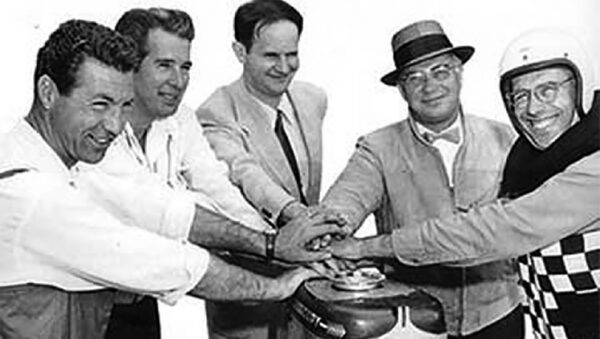
A lot of talent in one post-record photo (L-R): Jack Leek, Ted Jones, Charlie Strang, Carl Kiekhaefer and Hugh Entrop.
That’s what everyone who knows him says.
He’s got a memory that you can’t believe. He used to call me up once in awhile. It could be any time of the night. He might not be sleeping, he’d be up thinking about something. He might call me at 2:00 in the morning and wake me up and say, “Jack, do you remember back in 1950-something you did this and that?” I didn’t remember but generally he was right. He was writing an article or something and wanted to verify. But, this guy had a beautiful feature that we all appreciated. He was very careful in picking a man to do a job, but once he picked the man and gave him the job, then he kept his fingers out of it. He let the guy sink or swim on his own. He generally picked the right guy.
How about Bob Nordskog? You knew him.
I knew Bob quite well.
He raced a lot of different things.
Oh, yeah. I got acquainted with Bob when we were running the nine-hour enduro race at Parker. He was running a ski boat or a K boat, whatever you wanted to call it. It was a marathon boat, probably an 18-foot ski boat.
With an outboard?
No, with an inboard. Later on, when we got to the tunnel boats, we were running the six hours of Paris and Berlin and such, he wanted a hand in that and he wanted to learn to drive a tunnel boat. I loaned him an engine and pointed him in the right direction for boats. He got enough people around him to be able to do that. He was talented. It didn’t take him long to learn to fly a tunnel boat right. I don’t remember Bob ever going on his head in one. Bob had quite an industry, quite an empire there at Van Nuys. Nordskog built an awful lot of equipment that goes into commercial airliners, galley equipment and so on. Not only that, but ground support equipment like tractors and refuelers and all that. Boat racing was just a hobby, but he took it seriously. He had a beautiful shop down there with some fine workmen. They knew what they were doing, building inboard engines and later outboards. Bob was a good guy.
He probably got a bad rap for awhile with the offshore controversy in the early ‘80s.
Yes, he did. I’ve said this to his face, so I guess he won’t mind me saying it now that he’s dead. Being of Scandinavian descent, like I am, he was a little hard-headed in some respects. When he’d go into a project, like a race, he made sure that the people around him did everything they could to make things right. It was not just a hobby at that point. It was hard work and it was real serious to him. He didn’t stand for any foolishness. When it was over, if he’d won or lost, then it was back to fun and a hobby. But he was serious when it came to boat racing.
You’ve spoken a lot about C. W. “Doc” Jones. How would you characterize him to someone who never met him?
Maybe this will give you an insight to him. He and his brother, J.P., had a little grocery store and gas station, and they sold hardware. I’m not sure of the name of the town, but it was on old Highway 99, I think, just north of Marysville, California. I think they sold Scott-Atwaters. Doc had a little seven- or six-horse Scott-Atwater on a little boat back there that he was playing with. He couldn’t make it go fast enough. He was interested in outboards. Somehow he got acquainted with Elgin Gates. Elgin was a Mercury dealer and racer over in Needles. Somehow, Doc learned that the Mercury distributor for western Washington was Hunt Motet Company in Tacoma. I guess they weren’t doing a very good job and Carl (Kiekhaefer) was looking for somebody to be a distributor. He was going to combine True’s Distributing in Spokane and the one here and turn the whole territory into one distributor’s hands. All of Washington, northern Idaho, western Montana, and Alaska.
That’s a big assignment.
That’s a big assignment. Doc somehow or other won Carl’s favor. He and J.P. sold out this little store and came up here. They had between ‘em, as I understand it, $5,800 in their pockets. They got with a bank, the bank loaned ‘em the money to start this distributorship. That was 1950. Brought Elgin Gates along to do the parts stocking, repairing, and whatever was necessary. Doc and J.P. built that distributorship into one of the biggest in the country, which they sold out to Pacific Marine Supply. Elgin moved back to California to take over a distributorship down there with somebody else. I’m gonna guess 1955 or ‘56. Doc and J.P. stayed with Pacific Marine Supply for about a year and a half before they got this Evinrude distributorship. Doc was a salesman with a dynamic character; down to earth. He was going all the time, personally visiting dealers and helping them, just doing everything he could to make sure they were successful. J.P. was the financier. He kept the books and they didn’t get in each other’s hair. Generally, brothers don’t get along too well in business. Well, this couple did. They did a nice job. Doc helped so many people. Little things that you can never forget because they’re important. Everybody liked him. He was a businessman but not a pressure-cooker type. A good head and endearing. You didn’t lie to him. No, no. Just a straight, honest guy that understood what it was all about and liked people. I’ll tell you a story. You know Bob Jacobsen, “Tiny” Jacobsen? Jacobsen Boats and motors over in Ballard? (Seattle’s Ballard district was home to a large number of Scandinavian immigrants – Ed.)
Okay, sure.
Biggest Johnson dealer in the country, I think, at one point. Bob just got out of college. He came to Doc and said, “I’ve got a hole in the wall over in Ballard and I’d like to set up an outboard business. I’d like to sell Mercurys. But,” he said, “I don’t have much money. Can you help me ‘til I get on my feet?” Doc knew Bob because Bob raced with us. Bob raced D Hydro and everybody liked him. So, Doc, literally, helped him get in business. He was in business over there for two or three years but he came into Doc’s office one day. I just happened to be there. I didn’t want to interfere but I couldn’t help it. Tiny went into Doc’s office and he says, “Doc, you’ve done so much for me, I hate to do this, but I’m not selling engines over there. These people in Ballard don’t understand anything but ‘Yohnsons!’ I’ve got a possibility to take the Johnson franchise and that’s what they understand. That’s the only way I’m going to make any money.” Doc understood this.
How about Elgin Gates? He may have started racing in the ‘30s.
It could have been the late ‘30s, but I’m gonna say just before the war. He had built up a little outboard shop, hole in the wall, down in Needles. Everybody around the place knew him. Needles was a small town then; still is. Anyway, he raced an SR in B Class and I don’t know whether he had a PR or not. I think he did. I know he raced Midget. Then he got involved with the Mercurys and raced B and D Runabouts. He came with Doc to Seattle to run the service part of this distributorship they bought. Elgin knew Carl through racing. As a matter of fact, one of the first races that Carl sponsored and had going was the Lake Winnebago Marathon.
That was a famous marathon in those days.
Yeah. That was probably around 1950. It was when one of the first four-cylinders came out. Well, Elgin went back to run it. That’s where he got acquainted with Carl and some of the other guys in the factory. So, that was kind of a foot in the door for Doc. I think that was how Doc got with Mercury to get this distributorship, with Elgin’s help. Elgin stayed there until he went to California with this other fellow and took over distributorship for southern California for Mercury.
You knew him as a racer; what kind of racer was he?
Well, he was pretty good. I learned a lot from Elgin. He’d beat me once in awhile and I’d beat him. I remember they had a race over in Spokane at a little puddle called Shelly’s Sink. I don’t know whether you’ve ever heard of it or not.
No.
It’s down by Libertyville, on the east side of Spokane, out in the valley. It’s in a farmer’s back yard and it’s a pothole. It’s just about the size of a quarter-mile midget auto track. The banks came down deep so it makes a nice, natural amphitheater. There was a little lagoon or indentation on one side which makes a natural pit area. It didn’t interfere with the course. Harry Woods and I set that thing up when we found it in ‘48 or ‘49. We got acquainted with the farmer that owned it. We gave him some of the gate money. We made a little race course on this thing. It worked fine, but you needed a pretty small prop. Well, after I moved back to Tacoma, at Narrows Marine, in 1950, they were having another race over there. Elgin asked me about this thing. I told him about it. He says, “Let’s go.” So we loaded up that weekend and went and raced at Shelly’s Sink. I forget what the hell it was, whether it was a B Runabout or B Hydro, but he ran my ass off. I came and asked him, “What the hell are you running for a prop?” He says, “The smallest thing I got.” I said, “I’m already running the smallest B prop I got.” He said, “I didn’t say anything about what class, I said the smallest prop I got.” He was running his A prop on a B, and it worked great. I tried it the next heat and we had a lot of fun. That’s how small it was. Elgin knew what he was doing when it came to racing. And he was a good mechanic.
You knew Jerry Waldman. How do you remember him?
Jerry was a helluva neat guy. Sharp, knew what he was doing. I’d say Jerry was probably the best driver in the world. The best hydro driver. Real good.
What made him good?
Well, he just did a helluva lot of it. I know that Charlie was feeding him engines; stock engines and alky engines, out of the factory. I don’t think he was cheating, they were just the latest. But between him and Bobby Hering, nobody could beat ‘em there for a while. I got to know him quite well. Just a nice guy, the type of guy you’d want as a friend the rest of your life. That accident was just a sickening thing. I can’t remember exactly what happened, but I think somebody canned up right in front of him and he went into it. Didn’t have room to do anything else. (Waldman was killed in 1966 – Ed.)
You also knew Gerry Walin.
We used to call him The Phantom. He’d be going down the straightaway. He was so small he’d curl up in the boat and you couldn’t see if there was a driver in it. That’s how he got the name Phantom. Jimmy Hallum really got him going and built a lot of his equipment. Hallum could tell you more about him than I could.
We haven’t discussed the development of the OPC category. Were you involved with that when you went to work for Outboard Marine Corporation?
It had already started when I got into racing back there. They were running the crude catamarans. I can’t remember who built them. They weren’t any prize. There were a lot of Glasstrons, vee-bottoms and that sort of thing. The people who were running them, the drivers, were mostly just guys that had been enamored with running their Sunday afternoon ski rigs, or something. Some of ‘em were pretty good, don’t misunderstand, but most of ‘em weren’t guys that had been racing runabouts or hydros and knew how to read water well. When we got involved with it, when they dumped this race program on my shoulders, this was one of the categories we went after, primarily because you ran an absolute stock, off the production line engine in most classes. Then for the big classes you had the Quicksilver-type gearcase. It wasn’t a Quicksilver, it was…Speedmaster?
The OMC equivalent.
Yeah. Later, Charlie (Strang) built one that was even better than the Speedmaster. That’s what we put under the darn thing. The racing in Europe was more important to us than the racing in America, because the people over there really understood racing. Didn’t matter whether it was automobile racing or boat racing or whatever. They’re really high-performance minded, especially when it came to buying a product. Our distributors over there really wanted us to get into it. That’s another reason we chose that division of racing.
Along with preparing the engines and the boats and finding out what the hell we were doing there, I had to get drivers that I felt knew how to read water. The first thing I did was glom onto some of the guys that had been running runabouts and hydros for years and knew what they were doing. Ron Hill, he was good. I wanted to get Bobby Hering. I knew him, but he was so in with Mercury that he couldn’t let go of that. But most of the guys I got were former stock or alky racers. And it worked. These guys were winning races. So, then, Mercury caught on and did the same thing. We ended up with drivers that were pretty professional by the time we were through with it.
Jimbo McConnell was one…
Well, Jimbo had been a good stock driver. He came back from the Vietnam war and I ran into him out at Havasu. We needed a driver for a single-engine catamaran. He got in it and won the damn race for us.
What can you tell us about the OMC V-8 engine?
Those were fantastic machines. I wish you could see one of ‘em. Here was a three-litre engine that ran 11,000 rpm and pulled close to 500 horsepower. It was just like a Formula 1 automobile engine. $25,000 didn’t even cover our cost of the things. Con rod screws cost us $38 apiece, I think it was. There were four of ‘em per rod and you had to replace ‘em after every race. Generally, you should replace the rods, too. Crankshaft was $5,000. But, that’s how sophisticated it was getting. In Europe, it was Formula One, just like Formula 1 automobile racing. You know, the drivers were professional. They had great big trucks and sponsors. But the American public doesn’t care about it. We tried desperately to get TV caught up in it. A lot of the Formula One races here in this country had professional TV crews working. I’ve got the tapes. But, it still didn’t catch on. The public liked what they saw right there, but it still didn’t really help sell engines. And (sighs) I have to admit that I think just some stock racing, like our 45 cubic inch class, did as much as the Formula Ones, as far as selling the product. That’s the name of the game, you know, what are you doing it for? Trying to sell product.
Kiekhaefer made it work, to a degree.
Kiekhaefer made it work in the early days. Their reputation was built on high performance. They have been established for so long now that nobody even remembers those days, other than a few racers like us. The public sure as hell doesn’t. Nor the kids growing up, getting their daddy to buy an outboard. They aren’t racing now. They are a little…
A few.
But who the hell knows it? The public isn’t aware of it, doesn’t understand. They are familiar with the old reputation that Mercury knew how to build a race engine, too. Outboard Marine, we ran their ass off but nobody knew it because our P.R. department dropped the ball time after time. P.R. department didn’t care, and they kept trying to tell the top brass that we really didn’t need racing. Well, I guess they didn’t. And of course, they’re out of it now.
Yeah.
As a matter of fact, it’ll be interesting to see where Outboard Marine goes. They just sold out, you know.
Is boat racing always going to be a backyard sport?
I think it’s always going to be a backyard sport, at least here in the United States. I think it’s always going to be a hobby, a participant sport. And I don’t know as there’s a helluva lot wrong with that if you can do it cheap enough.
How about some of the big categories such as Unlimited or Offshore?
I don’t know what Offshore is doing now. I’ve totally lost track of it because they were so screwed up politically. The Unlimiteds haven’t changed their act for so many years. (Bill) Muncey and I were real close friends, and we used to sit and commiserate. He’d cry on my shoulder. “They’re falling apart and we can’t even finish a race. What can we do, Jack?” And I’d keep telling him, “You know, you’ve got a show, to hell with the race. Put on a show, that’s what you’re doing.” And I said, “For that, you don’t need hopped up engines, you don’t need the unreliability that you obviously have. Just take some stock aircraft engines out of the box and run ‘em. And so you’re doing 120 instead of 150 down the chute. The public doesn’t know that. The roostertail looks just as big and you’re making just as much noise. Put on a show at least until you get it built up again and get some action in it.” And at this point in history, I’ll bet you there aren’t eight of ‘em running and probably three of ‘em finishing.
They had some real bad times right before he was killed.
Yeah, and he wouldn’t do it.
Today, with the turbines…
Well, they’re a helluva lot more reliable but here again, why don’t they leave ‘em stock? Make sure they stay stock and they can’t hop ‘em up. But no, they aren’t gonna buy that either, you know? The turbine is probably the most reliable thing they’ve ever had. How can you hurt it unless you stick it under water when it’s running. It’s got all the power they want. Take the thing out of the crate from the helicopter and run it, you know? They’d have a helluva good show, but they aren’t gonna do it.
With all the things they change now, it’s so expensive.
Yeah, sure. You know, as far as I’m concerned, boat racing, hydro racing and so on should be kept as stock as you can make it so that you’ve got as much competition as you can get. Sure, make it interesting for the guy that wants to whittle on his motor, but still have some rules. Keep it within certain limitations.
To that end, do you feel there are too many classes?
Oh, yeah, way too many. I’ve said that so damn many times. How many classes are there now? I have no idea. You’ve got the alkys, hydros and runabouts; you’ve got the Stocks, hydros and runabouts; you’ve got the Modifieds, you’ve got OPCs, you got Offshore, you got Limited Inboards, you got Drags…
Inboard Endurance…
Yeah, and then the Unlimiteds. The general public doesn’t know a damn thing about what you’re talking about.
You still come around to some of Seattle Outboard Association’s races.
Oh, sure, I love to come to this type of race and see my old friends. But I really don’t care that much about the racing; it’s the same as it always was, you know? But I can’t ignore it, let’s put it that way. I sure as hell wouldn’t want to get back to running a professional team again. Those days are way behind me. Too much has changed. If you’re away from a sophisticated thing for a year, you’re out of it now.
From the time you started racing, you were a serious racer. It was not just fun; you were out there to win. Is that a fair assessment?
Yes it is, yes it is… I loved the racing itself, but I was married and had a family, and you weren’t making much money repairing outboards. I didn’t have an engineering job. I hadn’t used engineering, what I’d learned in school, for eight years or more. I’d forgotten, practically, most of it. So, I was using racing to get back to one of the factories, either Mercury or Outboard Marine. That’s exactly where I wanted to be. That’s what I’d gone to college for, really, so I could work on two-cycle research. It was fascinating to me. So, I was using racing as a steppingstone to get there. Well, it worked; it paid off for me. I took it seriously because I felt this was the only way I was gonna get where I wanted to go.
Well, thank you very much.
You’re welcome.
Editor’s note: Jack Leek was inducted into the APBA Honor Squadron in 1985.
Featured Articles