An Interview with Jack Leek
May 19, 2026 - 7:49pm
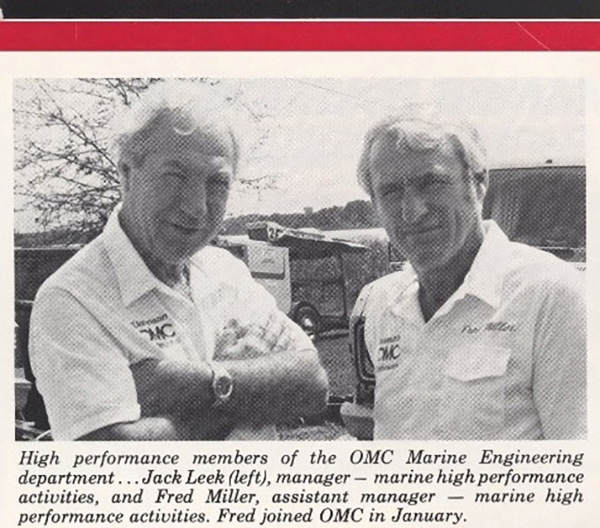
By Craig Fjarlie
Jack Leek ranks among the most significant men in boat racing, for his own accomplishments as well as his role in Outboard Marine Corporation’s racing program. Leek was born in Tacoma, Washington, where he was introduced to outboard racing shortly before World War II. Following service in the Navy, he returned to the Northwest where he studied engineering at Gonzaga University in Spokane. Racing became his passion, however, and before long he was back in Tacoma, making a name for himself on the racecourse and working at Narrows Marine. The following interview originally appeared in Seattle Outboard Association’s Pit Previews newsletter.
(Fjarlie) What was your first encounter with boats?
(Leek) My dad had a little six-horse and we did a lot of fishing. It wasn’t until high school days that I got acquainted with outboard racing. I can’t really say I raced then. I certainly was introduced to it by a couple of fellows. I think I took a ride in a C Service Runabout and another ride one day in a Midget Hydro. That gave me the bug.
You have an engineering degree from Gonzaga?
No, I don’t. To be honest with you, I don’t have the degree. I cut my senior year. I had been working with the Mercury distributor, True’s Distributing Company, in Spokane. They distributed Mercury outboards and Higgins boats in eastern Washington, northern Idaho, and western Montana. While trying to carry quite a few credits in college I still had time to work full-time there.
I ran their service department. Those years, in the late ‘40s and early ‘50s, the leisure boating business was just growing like a skyrocket. You couldn’t do anything wrong. People had been shut up from the war and had not had recreation. Carl Kiekhaefer made darn sure that all of his dealers got involved in some way with racing. That’s really one of the ways that Stock racing got going.
To back up a little, you raced a bit before the war.
One or two races. Just playing around with it.
Who introduced you to it, how did you find out about it?
I went to a race in Seattle and I think I met Len Keller, although I’m not sure he remembered it. I was just a kid standing around. I was fascinated with it, actually. It was a little regatta on the north end of Lake Washington. It wasn’t Kenmore.
They used to race at Juanita.
Maybe that was it.
That’s where Bill Rankin got involved. He went to a race there in about 1941.
Yeah, Johnny Sheriff was a real good driver and a good mechanic here in Tacoma. He had a C Racing Runabout; he may have had a Service, too. I think I went to this race to see him run. I met a few people, including Keller, and that’s where I got a ride in the Midget. Can’t remember the owner’s name…he had a couple Midgets and I think he had a C that he raced himself. He gave me a ride in his Midget. Anyway, put all this together and you got a young kid that’s kinda hooked. I ran a couple of heats one day. You can’t really say you’re racing doing that. You’re learning.
It wasn’t until after the war that I really got racing. Harry Woods, myself, and Paul True started the Spokane Outboard Club. That was a nice little club. We were primarily involved with the Stock program, Mercurys. Obviously, we were selling them.
Was this an APBA club?
No, it wasn’t. We kinda started on our own over there.
When you started racing in Spokane after the war, how did you get your equipment?
As a matter of fact, I can’t really call it my own equipment to start with. It belonged to the store, to Paul True. Paul had raced back in the ‘30s. He liked it, so when I took an interest in it, he helped me. There was a particular type of boat that Chuck Hickling was building in Seattle, and I knew Chuck. We bought a bunch of them—B Runabouts.
They were Hickling’s own brand?
Oh, yeah. He designed and built them in his garage. I was buying them over there and selling them. We were sticking 10-horse Mercurys on ‘em. That was the B class.
Chuck was building runabouts?
Yeah, and the hydros we’d pick up from alky drivers, wherever we could find one, whether it be a Jacoby or a Neal. Most of ‘em were conventionals (step hydros) to start with. There were a couple of Neal three-points. About this time Joe Swift started building what I called orange crates, the Swift hydros. They turned out real good; they were a nice little hydro.
How would you compare driving a conventional hydro with a three-pointer? Were the conventionals tricky to drive?
Not really, not when you knew what they were and what they were supposed to do. Between a conventional step hydro and a three-point, it’s two different techniques altogether. In the conventional hydro, you turned on the outside chine and you used ‘em primarily for rough water and short courses. In fact, there was a time when I carried both the three-point and conventional on the trailer, just in case we ran in real rough water, which we did a few times. But eventually it turned out that the three-points were so much faster that you just ignored the conventional. But a conventional, when you get to the corner, at the same time you turn the wheel you plant your knee on the outside over against the floor so that you’re distributing your weight on the outside. The hull actually rocks up a little on its outboard chine and you just go right around the corner like you’re on a rail. Beautiful.
What kind of fin would you use on the conventional?
Well, in those days you had a little skid fin right in the center, right behind the step.
How different was a runabout from a conventional hydro?
Oh, quite a bit. In a conventional hydro, you don’t have to shift your weight forward or aft. You know by testing your set-ups and so on where you want your weight in the boat. It’s not that touchy, you’re not trying to fly it. You want that front step pad touching the water once in awhile. On a three-point, you’re trying to fly it and keep it off the water. It’s a delicate balance whether you’re gonna go over backwards or stay right-side up. Well, you learn that pretty quickly.
In a runabout, you try to keep your weight right in the back end. In fact, I knew some guys that used to crouch. When they were crouched, they would cross their legs and put their feet right at the transom, literally, down the straightaway, be standing on their feet so that’s where the weight was distributed. It wasn’t legal. You were supposed to have a little better grasp of the boat. But you wanted your weight back in order to get the bow up and keep it free. If you kick the engine out you can do the same thing, except you’re losing speed. So, your weight distribution would make the boat free. I don’t think that’s changed through the years.
How did it happen that you came back to Tacoma?
In 1950 I was married and had a son, and decided there was more money dropped accidentally in the retail market in the Seattle-Tacoma area than there was spent on purpose in Spokane. So, I moved back to Tacoma, Narrows Marine, and started selling Mercurys again over there.
The marina was already in existence, you just took a job there?
Right. They were kind of running it as a hobby. There were two brothers who owned it. One was a city commissioner and he kind of stuck his nose in once in awhile and handled the business end, the accounting. The other was a little more hands-on. He worked for Ma Bell and he’d be out every afternoon and evening and all weekend. He pretty much was the mover behind boats, engines, and fishing gear and getting the marina going. I fit in, in the respect that I opened up the service shop and got some engines in there.
I think when I got there, there were three five-horse Mercurys. I think I asked him, “Why don’t you get some 10-horses in there and make some money?” He says, “I don’t think we can sell ‘em.” It was about that time that Doc Jones had moved up from California and taken over the Mercury distributorship in Seattle. I went to him and swapped these five-horses for a couple of 10s and a bunch of parts, and we literally got going in the dealership that way. It worked into a pretty nice little dealership over the years. In the meantime, we were racing and the Stock program was growing in Seattle. I think I ended up having an A Stock Runabout, an A Stock Hydro, a B Stock Runabout, a B Stock Hydro, and a D Hydro.
You did most of your own mechanical work?
Oh, yeah, all of it.
Were you self-taught, or did you have a mentor?
I learned myself, by trial and error. Bill Rankin taught me a lot of tips about engines. I guess everybody you come in contact with could offer something. I think most of it is set-up and props. You can have the best engine in the world, but if you’ve got a bad prop, you aren’t going anyplace.
Who did your prop work in those days?
I didn’t do any prop work myself. Most of the props I was running came from right out of the box, Mercury, or O.J. Johnson of Oakland were pretty good at that time.
What can you tell us about O.J. Johnson?
They were bronze props and pretty thin. Different kind of shape than most of ‘em, although his shape now is pretty conventional. A lot of people copied it because it worked.
It was about this time, while you were at Narrows Marine, that you met Burt Ross.
He was still in college, playing football. He saw the rig and decided that was for him. He wanted to know more about boat racing. I took him to a race over in Spokane, just to help me in the pits, because he was so interested. I put him in the A Runabout and let him play with it and he looked like he knew what he was doing and could handle it. So when it came time to race I said, “You can run it. You gotta sign up.” And he did. This is an interesting story about Burt. I don’t know whether you’ve heard it or not, but the guy had never run a race. I pointed out a couple of guys that I knew in this heat he was going to run, that knew what they were doing, and I said, “Now, follow them. Don’t try to win anything, I don’t want you to get this thing too wet and I don’t want you to dump it. I just want you to learn what the flags are and what the thing’s all about. You do what I tell you and then we’ll get you racing from that point on.” Well, when they came up to the starting line there wasn’t anybody in time for the gun and he was the only one even close to the starting line, so he squeezed it and won his first race. There wasn’t much I could tell him after that. The guy had a tremendous sense of timing and a great ability in all sports, for that matter. He just took to boat racing; he loved it. So, from that point on, he stayed with me and raced a lot of my equipment, mostly the D Hydro.
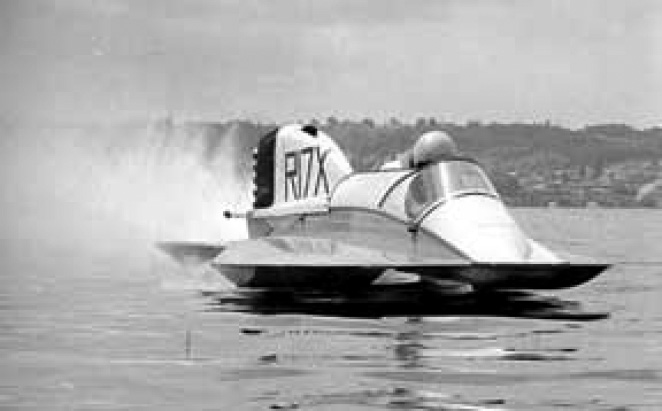
In yet another venture, Jack’s expertise helped Burt Ross to a record of 115.507 MPH.
In 1954, you did some development work on a Mercury and turned it into an Alky engine.
It was a bunch of scrap parts.
What can you tell us about that project?
Over the winter I decided, “Let’s try Alky.” I didn’t know whether it would compete with a KR Johnson or not. I think the straightaway that Bill Tenney had was 53 miles an hour. Stocks, we were running 50 or 51.
You were right there, anyway.
Yeah. I never had stuck alcohol in it and raised the compression, so I thought, “Let’s see what we can do.” I didn’t want to mess up my good stock A because I was still running it. So, I gathered up a bunch of spare parts at the shop.
This is at Narrows Marine?
Yeah. I built myself a little dyno, if you want to call it a dynamometer. It was a driveshaft housing with a flat disc on the bottom. If I kept the water level at exactly the same height all the time, it gave me pretty reliable readings. So, I ground out, by hand, all the rust marks from the con rods and sanded a crankshaft that was all rusty and literally built this engine out of scrap pieces. I think the only thing in it that wasn’t Mercury were the pistons, and that was just because I couldn’t get any semi-finished pistons out of Mercury. I fitted ‘em to my own clearances.
What did you use for pistons?
I think they were Wiseman. Clyde Wiseman was building some. Probably weren’t as good as production Mercury pistons. They were two-ring instead of three-ring. And I think I squared the exhaust ports and raised them a little, maybe 40 thousandths.
Did you pad the cylinders?
No, I didn’t. I couldn’t figure out how to do that without messing up. I was afraid to weld on the cylinder for fear of distorting it, so left that stock. Anyway, when we ran the damn thing, it ran so well that I was afraid to mess with it any more until we’d done something. The first time I took it out to the lake to run it, kind of break it in, I was reading, I think, something like 54 and a half with a competition set-up. It was later on that I jacked it up and put the straightaway set-up on it, and a different prop, and I was reading 57 and-a-half dragging the pitot tube. So, I didn’t even touch it until they had the straightaway run over at the East Channel (on Lake Washington). We took a set of runs and I came out with a 61, and I was surprised as much as anyone. I knew it was gonna be a record, but I didn’t know it was going to be that high.
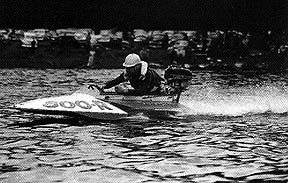
1954 – Jack’s A Hydro raises the mile record by 7 mph to 61.069!
What kind of hull did you run?
That was a Swift, orange crate.
And the props?
They were straight out of Johnson, Oakland.
Later you had a Racing C and hoped to run 80 miles an hour.
I built it. Hugh Entrop helped me design that and I built it at Narrows Marine. It was almost a duplicate of Hugh’s F boat, the cabover.
The one he set the straightaway record with?
Yeah. I was trying to make it prop ride like we did the F. Why change that? Could never get it to prop ride, but at least it went 80 miles an hour.
You went to the Nationals with it and won.
Yeah, it was 1959.
About the same time, you were involved with a project on the Mercury B, developing a tuned exhaust. What can you tell us about that?
It wasn’t my project. That came from Oshkosh, from the Mercury labs. It was winter and the Hot Rod was running the tail off the Mercury. Not in the straightaway, particularly, but around the course.
It could accelerate faster?
Yeah, and Mercury, the guys at the lab back there, finally determined it was due to some tuning in the exhaust system that Hot Rod had inadvertently come up with. The Mercury was de-tuned down through the exhaust system, for some strange reason they couldn’t figure out why. They finally gave up trying to find out why. They just went ahead and built some tuned exhaust in it. I think that was the first time we’d played with tuned exhaust in the country. Dieter Konig had put tuned exhaust in his race engines in Europe and the first time we saw those was in 1957 at Shreveport, the Alky Nationals.
Anyway, they (Mercury) did a nice job building these stacks into the driveshaft housing, but it was winter and they needed to test it. They didn’t have anybody down in Florida to test it. So, Charlie (Strang) called me and he said, “Are you set up to test out there?” He knew I had a B Stock engine that he had shipped me. I was on a retainer during that time. So, I said, “Sure.” We used the engine he had shipped out to use as a base for any kind of testing. Then he shipped out this array of welded up pieces of sheet metal. It was the damndest thing you ever saw. This whole thing, from the cylinder block down, was little pieces of sheet metal that were welded together to form this thing. I’ll bet you there wasn’t a section in there over an inch long without a weld, for both pipes. They were interwound, just like they did in the casting that was eventually built. This was the prototype he sent out. He said, “I don’t know how many runs you’ll get out of it, but we’ve already got some runs on the dyno, now see what it’ll do on the boat.” So, we set it up on the rig and I tested it. Backed the spark way down ‘cause it didn’t need it, the spark was advanced so far. It was going like hell. To verify it, I got Billy Schumacher. He had a Hot Rod and he was running everybody’s tail off in B Stock Hydro with that Hot Rod. He came over for a day and I got a course set up and we ran it on my boat. I ran it and he ran it. Then we put it on his boat and did the same thing. There was no question that this thing was gonna run the tail off any Hot Rod.
They’d made an advancement.
You bet. I got hold of Strang that night when we were through with those tests, probably about 1:30 or 2:00 in the morning his time and told him the results. He was happier than hell. They went ahead and built it.
Speaking of Billy Schumacher, he was an obvious talent.
You bet. He lived right on Lake Washington and his dad was real adamant about him driving. Bill, Sr., was a helluva nice guy, but he just made Bill go out and run that damn boat, regardless of which one it was. Bill, Sr., just kept on him. He had to go out and run so many hours after school every night, just like homework. He got pretty good. So Billy grew up running all the time and testing. I liked Bill, he was a nice kid. He did his homework. He turned out to be a helluva driver.
Hugh Entrop had heard about a six-cylinder engine being developed by Mercury, so he built a boat for it. Then the engine didn’t come out so the boat sat for a couple of years.
Here’s exactly the way it happened. Hugh had the boat and we talked, the two of us, over dinner or martinis or whatever, how to make a boat prop-ride like an inboard. We felt as soon as we did, we’d really reduce friction and we should be able to set some records. In anticipation of a six-cylinder Mercury coming out with a racing gearcase on it, he built this boat. It was a beauty but there wasn’t anything to hang on it to know whether it’d work or not. It was in the winter, in December I think, of 1957. Charlie Strang called me at home in Tacoma. He asked me if I could get Entrop away from work for maybe a month. I said, “I don’t know, what have you got in mind?” He said, “We’ve finally got a prototype of a six-cylinder engine with a racing gearcase. I understand Entrop’s got a boat that would be ideally suited for it.” Of course Charlie, at this time, was familiar with the stuff we’d been racing in F class with the four-cylinder and doing very well. So I said, “Let me talk to him. If we can break him free, then what?” He said, “Then you’ve gotta bring the boat down to Florida and we’ll set up a straightaway and we’ll try to break the record.” Sounded great, so I said, “I’ll get back to you.”
I got hold of Entrop. It was a Sunday afternoon and it was colder than hell outside; it was midwinter. Entrop was very enthused over this. He said, “Let me call my boss and see if I can get a leave of absence. Maybe I’ll have you call him afterwards, or he can call you, and verify all this.” I don’t remember the details of all that, but we did break Hugh free from work for a period of a month; month and-a-half, maybe. Hugh and I, with his 1950 DeSoto with the boat on top, took off and drove to Florida.
We were supposed to run this over on Lake X. Well, where’s Lake X? Nobody would tell us; this was super-secret. We were at Mercury’s test basin at Midnight Pass, Sarasota. About two days after arriving, Carl Kiekhaefer apparently had called Joe Anderson, who was the base manager there, and told him to get Entrop and Leek up to New York because the New York boat show was going on and the boat Bill Tenney was driving with the McCulloch engine on it (McCulloch had just purchased the Scott-Atwater line – Ed.) was at that boat show and he wanted us to see it. So, they put us on an airplane and we flew to New York and then spent three days in a hotel room waiting for Carl to take us to the boat show. It was absolutely ridiculous. Entrop was fit to be tied; he wanted to go home right now and I couldn’t blame him. I was trying to hold this thing together knowing it would blow over and we’d get to run. Finally, we got to the boat show on about the fourth day, I guess through Charlie Strang being a mediator and quieting Carl down and letting us go by ourselves. Carl had insisted he’d take us himself, but that didn’t work. We spent a day looking at that thing at the boat show and decided it was a fiasco. When we reported that to Carl, he decided okay, let’s get back down to Florida and get to work. So that night, we climbed on his twin Beech, with a pilot who was already worn out from flying, and he flew us to Sarasota. And then he got fired because he wouldn’t fly the airplane back. He was all by himself—no co-pilot or anything—but that was Carl.
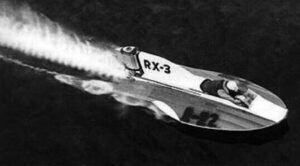
With Jack’s help, Hugh Entrop recorded a speed of 107.821 MPH in 1958.
We spent the better part of three weeks down there testing and we really didn’t have any propellers. Everything was Don Henrich, the propeller man for Mercury at the time, but he was not familiar with surfacing props. We had called Hi Johnson to try to get him to build a left-hand rotation outboard prop and he wouldn’t do it. About that time, Hugh had to get back to work, no question about it. He was already going to be late; we made a couple of calls to Boeing to smooth the waters for him. Hugh ended up flying home, as much as he hated to fly, and I drove the old DeSoto and the boat back to Washington. I can’t remember the details of how we did it, but I spent another week and-a-half or two weeks after he went home trying to sell Charlie Strang on carrying on the project in Seattle. He sold Carl on the idea and so we did it. Operated out of Ted Jones’ boathouse.
On the East Channel of Lake Washington?
Yeah, on the East Channel. And ultimately it became successful and we were very happy with it. I might add – I don’t know whether Entrop told you this or not – we must have made six or eight runs over 100 miles an hour and didn’t know it. No matter what we did, what props we put on or anything else, we’d read 96 miles an hour. We were getting pretty damn frustrated. You had to wait for the right winds and everything. Well, the boat looked like it was going, but the speedometer wasn’t reading it. Finally, one afternoon, Entrop found that there was a leak in the pitot tube. The pitot tube was built into the skid fin. Eventually we were going to take it off anyway. When we finally fixed the leak, we were running 110 and had been all this time and didn’t realize it. So, everything looked pretty good. I called the factory and told Charlie what we were doing, and we were ready anytime. They were out there the next day and we ran successfully. (Entrop set the straightaway record at 107.821 mph in 1958.)
Who made the prop, was it Ron Jones?
That’s a very good point. That was Ronnie Jones, and that was one of the reasons I wanted to come back, because we needed props. We weren’t going anyplace without the right props. So, Ron Jones immediately went to work and built a pattern for it. I guess he had a couple of props that we ran, and that did the job.
Was it a three-blade or two-blade?
It was a two-blade. I should include one other thing. The one thing we did down at Lake X, as they called it, we had tucked the engine under six degrees to simulate an inboard shaft coming down at about six degrees. We finally made the damn thing propride, the first time I’d ever seen an outboard propride. I was so excited I waded out clear to my chin. Filled the waders full, but it was a beautiful sight. With this information we knew that we could propride with the right prop. So then it was reasonable to move the whole project back to Seattle.
You went back down to Florida about a year later.
When they opened up Lake X, they had a big party for all the dealers and the press. When we first went there it was a jungle. They had turned it into a new proving ground with boathouses and docks and the whole business, and even a motel for sleeping quarters. It was a nice facility. We were down there to inaugurate it. While we were there, Carl had set up a straightaway—kilometer—and insisted that we stay there and run a new record in front of the press. Well, the wind blew and the press went home and we had the National Championships coming up over at Lake Alfred. So we weren’t going to stay there, and we didn’t. Carl was mad again.
It got to be a crisis because the two of you couldn’t get the boat up on the car, so Kiekhaefer’s son-in-law helped you.
That’s right. Carl had given orders that nobody was to help us get that boat up. We had to stay. We were literally locked in, but somebody took pity on us.
Then on the way home, Entrop stopped in Phoenix and saw Doc Jones and told him he was going to switch to Evinrude.
Right.
Was that a surprise to you?
I didn’t know that. They had their own private meeting. I couldn’t blame him a damn bit, you know?
Was it a shock to you to hear it?
No, not at all. Doc was probably the best friend I ever had, and I think Hugh could say the same thing. Doc had helped both of us through our racing careers, ‘cause neither of us had any money. But at this point, you know, he was an Evinrude dealer. So, when he offered this to Entrop, no, it didn’t surprise me. I didn’t know about it until later.
After you got home.
Yeah. It was well into the planning stages, as a matter of fact. We were going to run the last race of the season down at Lincoln City, D Lake, for records. I think that’s when I heard about it. Entrop and I went down together and while there, met two gentlemen. One of them was Clay Conover, who was director of Marine Engineering for Outboard Marine Corporation.
He and Doc were having dinner one night. Doc came over and apologized; he wanted to steal Entrop away from me for a little while for conversation. Entrop had warned me that they were going to have a meeting, but he’d tell me about it later. Well, before the dinner was over, Doc came over and got me at my table and introduced me to Clay and the other gentleman who was the chief engineer, Dick Hulsebus. Dick later turned out to be my boss—a great guy who taught me some pretty good engineering while I was working there. Before we said goodnight, Clay Conover told me if I ever got tired of working for Carl to let him know, because he’d like very much to have me back there. Well, that was very flattering and hell, it was what I’d gone to college for. So, when I finally couldn’t stand Carl anymore, I took him up on it.
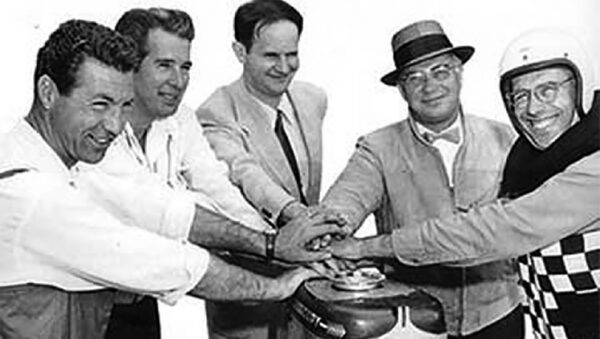
Posing for a post-record photo (left to right) are Jack Leek, Ted Jones, Charlie Strang, Carl Kiekhaefer and Hugh Entrop.
This is the end of part one of the interview with Jack Leek. Next month, in part two, Leek discusses working with Burt Ross and remembers a number of famous racers he knew.
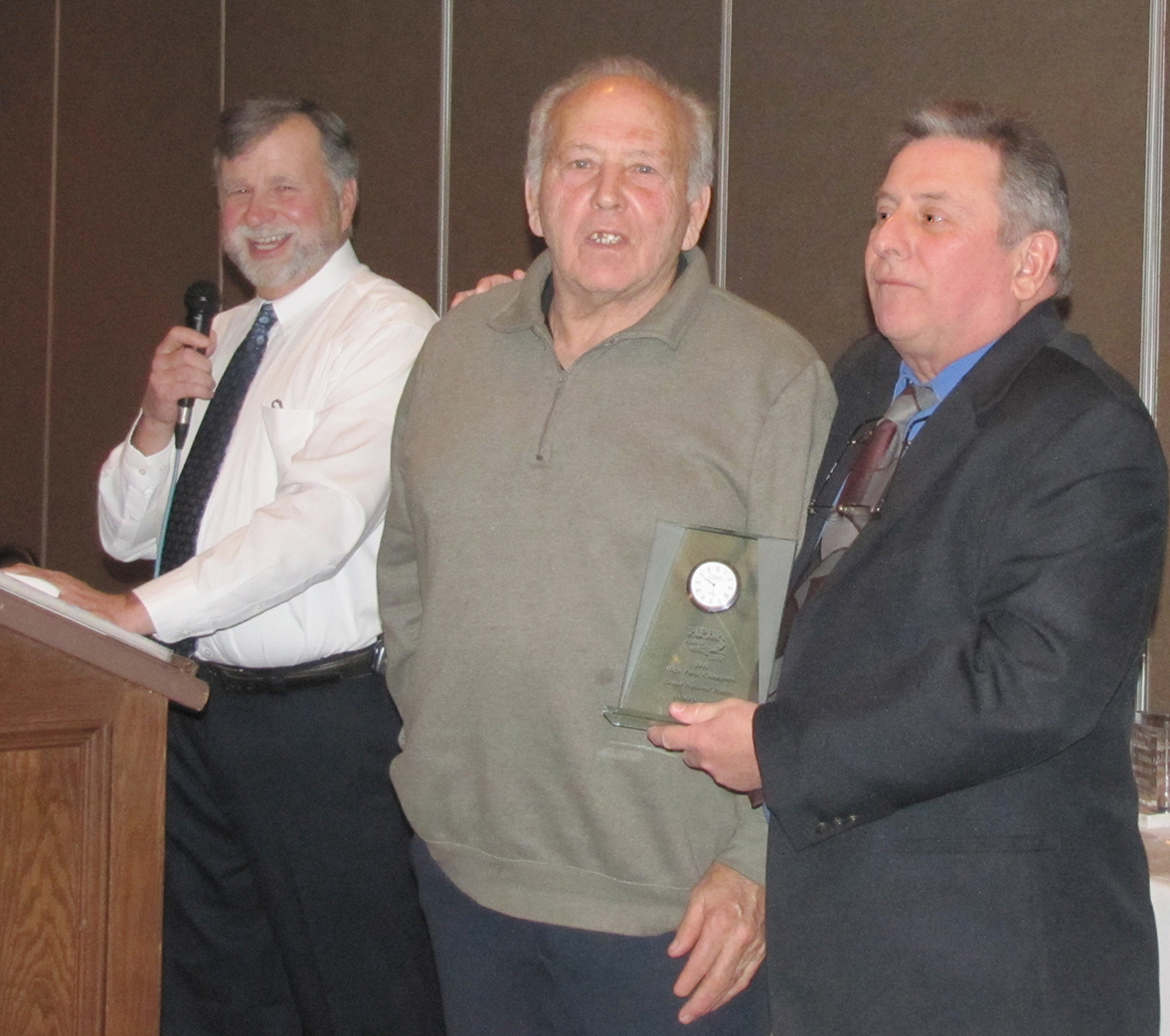
Jack Leek was inducted into the APBA Honor Squadron in 1985 along with Glenn Davis and Henry (“Shakey”) Shakeshaft Jr.
Featured Articles