Racer Profile: Chuck Walters
March 31, 2026 - 3:26pm
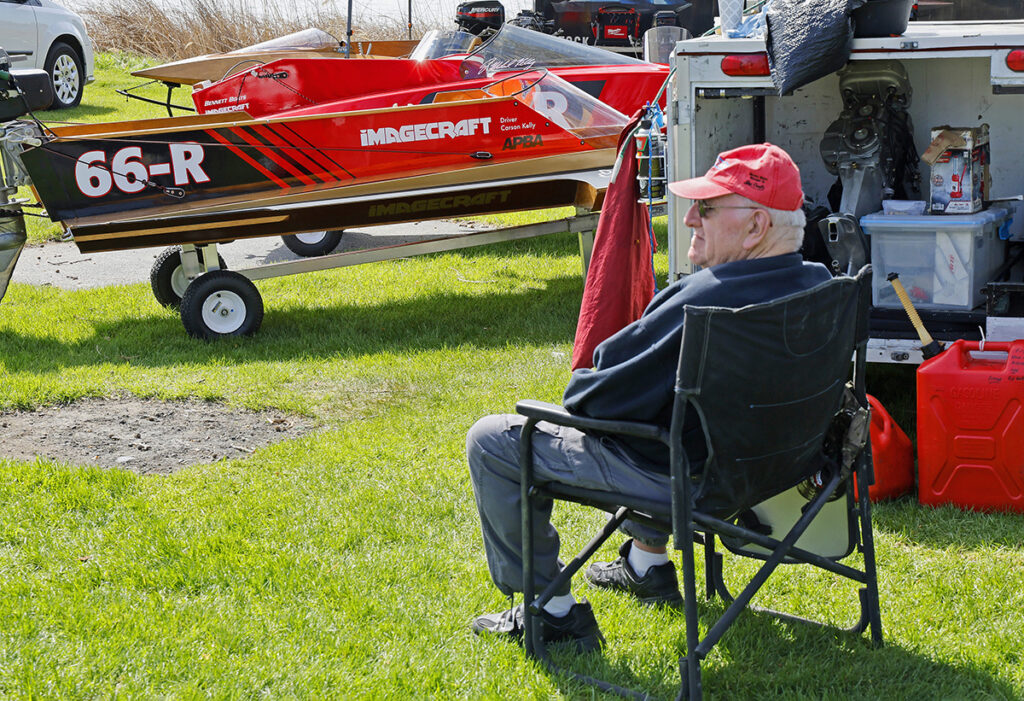
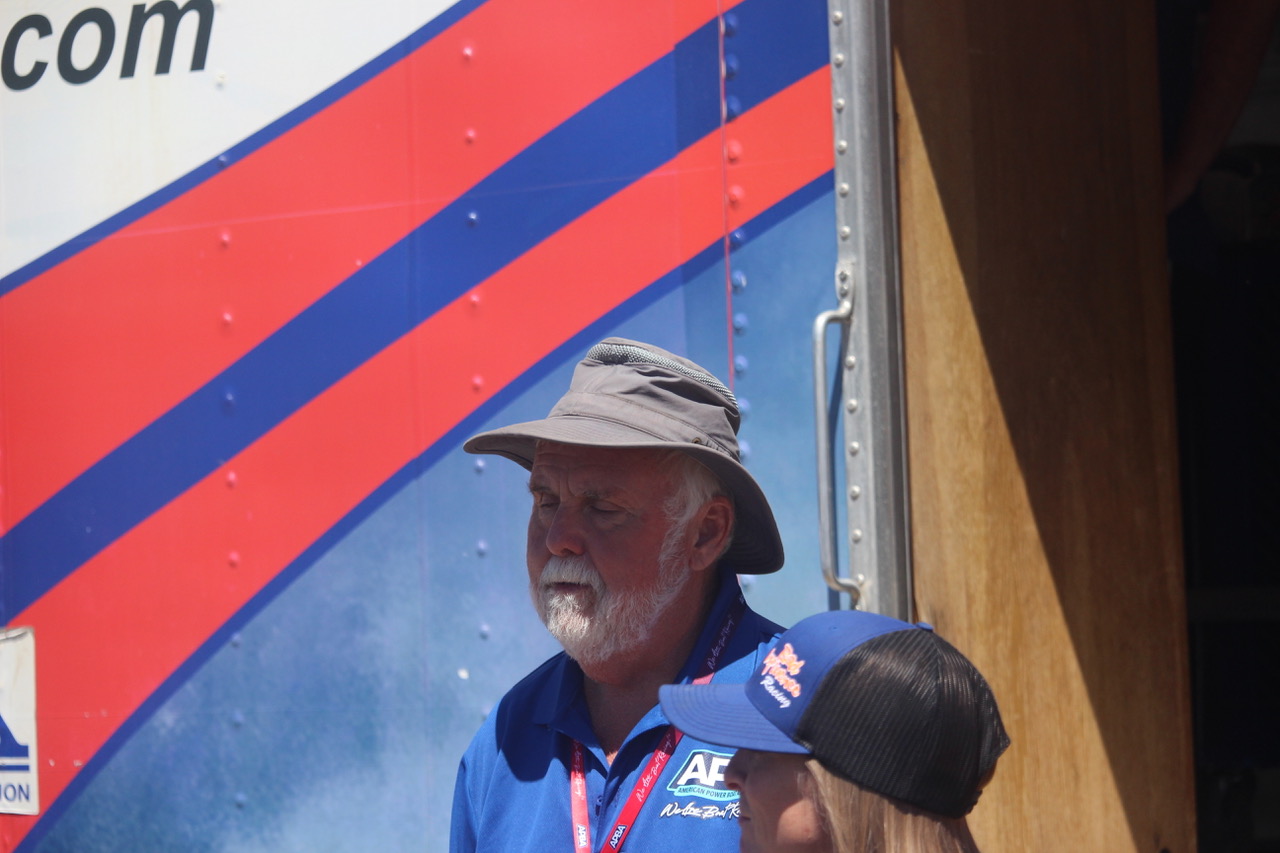
Chuck Walters in the pits at an outboard race at Moses Lake, Washington, in 2025. The boats are owned by his long-time racing friend Lee Sutter. (He’s wearing a Sutter’s Gold hat.) Photo by Gleason Racing Photography.
By Craig Fjarlie
Chuck Walters has been involved with racing almost all of his life. He was born in Seattle in 1947 and lived there for 20 years. He then moved to the town of Kenmore at the north end of Lake Washington, where the Sammamish Slough empties into the lake. His father, Bud Walters, briefly participated in the historic Sammamish Slough race.
“His first Slough race, when he got out of high school, was when they started from Madison Park,” Chuck explains. “He ran what you would now call a C Service Runabout. He crossed the lake, up the river to Sammamish, and back. He won that year, but they didn’t give him the trophy because he wouldn’t join SOA (Seattle Outboard Association). I think Al Benson ended up winning.”
Bud took a few years off from racing, but in 1955 helped his son start in JU, now known as J Runabout. The following profile is based on a 2016 interview with Chuck.
The younger Walters attended college for about two years. “Still lived at home and worked for my dad,” he says. “When I was 21, I ended up getting married and of course, moved away from home. But most of those years I was boat racing.”
Chuck obtained his first JU from Al Benson. “I think anybody who started racing at that time started with Al Benson,” he remarks. “We ran that for one year. It was pretty heavy, so in 1956 dad had Eddie (Karelsen) build us a boat. Pretty much all of the new guys were running the same type of boat at that time. Billy (Schumacher) was running a runabout like that, Jimmy and Donnie Benson, Chuck Lyford, Jackie Holden were all running the same boat. The rules changed in 1958; you didn’t have to run a 10-foot boat anymore. It could be nine feet. That’s when they started bobbing the nose, making them nine feet. So dad built one. It was a copy of a Karelsen, up to the part that got cut off.”
In 1957, Bud Walters started racing again. “He got together with Hugh (Entrop) and Sam Bell and they helped him design a cabover that my dad built,” Chuck remembers. “The second one he built was ‘59, and then from 1960 he was running Ron Jones boats. He didn’t have time to build boats anymore because of the business.”
Chuck specifically remembers the 1959 Stock Outboard Nationals at Green Lake in Seattle. “I think I got a second in elimination and then a third or fourth in the finals. All the hot dogs were here, the Bowmans and everybody from the East Coast and of course Jackie Holden. He had set all the competition records and the straightaway records at the time. He was always about a mile an hour faster. It doesn’t sound like much, but in those little things on a mile and two-thirds course, that was a long way. The best I ever got was almost 28 miles an hour, but the best Holden ever got was about 29. He set all the records and won the Nationals. That was in the days before we knew what to do with the bottom of a runabout. We never ground them—we didn’t know. Somehow, Holden knew about that. So, then I moved from JU to A Stock.”
Chuck competed in both A Stock Hydro and Runabout. “We got the old boat that Eddie Karelsen built for JU out of mothballs. Then for Hydro, the first boat dad bought was a Fillinger. It was Val Hallum’s boat. The next year he bought the Fillinger that Gerry Walin ran, but he was running the KRs. So, we picked up a little speed there. In 1961 I was old enough I could run A Racing Hydro. I ran a Mercury Deflector on the Karelsen boat. Jack Livie and Gerry Walin were running SidCrafts with Anzanis on them. I was running the Deflector but I got high points that year. Any time I could run an alky motor I was happy.”
Bud and Chuck Walters made a deal with another outboard racer to trade boats. “His son was getting old enough to run J. Dad said, ‘You build me a Racing A. We’ll build you a runabout so you can run J and then A Stock Runabout when you get ready.’ So, we traded boats. That boat was faster than a Karelsen by two or three miles an hour. I blew the thing over three times. I remember one time in Olympia, I was chasing Bob Reins. I turned around and looked to see where everybody was, and I noticed the cover on my carburetor had dropped down so I was getting direct air into the carburetor. In those days we used to run a little angle-type of aluminum bolted to the side of the Johnson carburetor and that would protect it from getting water or too much air into it. I thought I’d better move back in the boat to keep the air from going directly into the engine. About that time, it got up and poof! Over backwards. The second time I did that we were racing down at Long Beach in what we called the cranberry bog. It was a neat place. One of the guys that raced A Hydro, his dad owned it. Came out of the corner, three of us together. I was in the middle. We headed down the straightaway and they out-accelerated me because they were running Anzanis. They both kind of took off and I’m stuck in the middle, getting air off their boats, and poof! Away I go. Thought I was gonna drown. Guy in the patrol boat says, ‘Well, stand up.’ I was only in about this much water (gestures, shoulder high) because of the cranberry bogs.” Chuck’s third blowover occurred at Moses Lake, when he tried a borrowed propeller. The boat was faster, but he hit rough water and blew over. “From ‘64 on, I just mainly ran Alky,” he says.
In 1967, Chuck stepped up to D Hydro and F Hydro and F Runabout. “I won F Runabout Nationals on Green Lake,” he remembers. “1967 is when Tom O’Neill stuck his girlfriend in my boat. I ended up marrying her the following year. But we had a full class in F Runabout. I was right there, got good starts, got to the pins on the inside. Once I got away from the other guys it was clear sailing.”
In the early ‘70s, Chuck had an opportunity to drive an Unlimited hydroplane owned by Bob Gilliam, whom he knew from outboard racing. “Gilliam was running pretty much all over the country,” he recalls. “He was running the boat as Pizza Pete. Then he bought another boat and that was Pizza Pete. The Valu Mart was a smaller boat that he built. He said, ‘If you guys want to take this boat, paint it up and re-rig it.’ When he was running it, it was rigged for a Rolls-Merlin. He said, ‘We’ve got plenty of Allisons, you guys can run it at Seattle and maybe Tri-Cities.’ We didn’t get it done for TriCities—we almost didn’t get it done for Seattle. There were only three of us working on it. Dick Rautenberg was on the crew, but Dick could help sand—and another fellow by the name of Dave Griffith. We got it all re-rigged and sanded down. I painted it. I got enough sponsorship from Sunny Jim to get it lettered. We went and put the engine in it. We didn’t see the magneto was bent, because it did spark. It just didn’t spark enough. We used one of the trucks to tow it down to the pits. They only had one engine. If that one went bad, that’s all we had.”
Chuck was unable to qualify the boat, but he did take it out for a test run the day after the race. “It was different. Bob was riding with me, and I’m in the driver’s seat. I’m steering and Bob is trying to ride and hold on to whatever he could hold onto, riding on the deck, trying to adjust things on the dashboard so it would run halfway decently. He didn’t even have a life jacket on! Anyway, we ran around the course and came back in. That was about all the time we had.”
Chuck operated a marina from 1976 to ‘79. “I started my shop at Juanita Beach,” he says. “Somebody wanted to buy the property, so I moved to Redmond. I serviced Mercury outboards and inboard-outboards. I got into the dealership because I was the only high-performance dealership in the Northwest. So, if somebody wanted high-performance stuff they’d come to me and I’d get it for them. But, much of the stuff we sold was the same as went into a stock motor. We didn’t have very much space in Redmond when I moved the shop over there. Jack Livie would come over after work. I’d schedule boats to come in, like a lot of the inboards, inboard-outboards that were on Lake Sammamish. They’d need water pump service or whatever. We’d do them in the parking lot. Some of them we just did across the street. We’d run a hose out there, tear it down, put all new pumps and gaskets in it, put it back together, hook up the water to it and make sure it pumped water and ran. We had a good time there for quite a while.”
Through his marina business, Chuck met people who were racing tunnel outboards. “In ‘78 or so, I built a Mod 50,” he notes. “With my dealership I got a motor with all the parts and stuff. It was a Mod 50 engine. I ran it for a couple of races. About that time, Bob Hering and I traded. He was going to run on the Mod 50 circuit with the Formula 1s, so he wanted my motor. He was going to give me a boat, an SST 120. So he got the motor and I got the boat.” Chuck obtained an inline six-cylinder engine so he could run Mod 110, and he had a V-6 for SST 120. “I set up my tower so if we went to a race where both classes were running, I could pull the powerhead of the six-banger off and put the V-6 on. So, I ran both classes that year. It was a good year for me. I ended up winning Region 10 SST 120, and I won a Mod 110 marathon.” In the fall, he took the boat to Devil’s Lake, Oregon. “I just wanted to get in the 100 Mile an Hour Club and I didn’t want to hang it out and blow it over like all these other guys. I went right out of the pits, hung a left, and right to the pits. Competition wheel and everything. I ran 107. I got the Babcock award for that.”
A World’s Fair was held in Vancouver, Canada, in 1986. Organizers of the event had a Formula 1 tunnel outboard race on the program. “They called down and said, ‘We’re going to be short of boats. If you want to bring your boat up, we’ll help you out when we can.’ So, I brought my boat up and so did Rick Adams,” Chuck says. “I qualified last, but I got in. Brought it home. I get a call from Barry (Woods) and he says, ‘Can you get back to Minnesota and work with the crew the rest of the season? I’ve got an extra boat you can drive when you’re not working on our boats.’ I fly back there on Wednesday. It is hot and humid like you can’t believe. They still had work to do. I had the Molinari boat that Barry crashed into the bridge when he was testing here at Lake Washington one year. I was running a six carbureted engine; they were running injected motors. The first race was St. Paul. I qualified—I was running about seventh. The prop shaft broke, lost the prop. So, I didn’t get to finish that one. We took it back and rebuilt the gear case. They were all working together as Cees van der Velden’s team and Barry Woods’ team. This guy in Waukegan was a friend of Cees. He was Evinrude. They were all running OMC. They had a big marina there. In the summer he wasn’t busy because all the boats were on the lake fishing. We used part of the shop to work on our boats. We had a motor shop and a boat shop. I was in charge of getting the boats that had to be rebuilt, with paint guns and lettering, getting them ready for racing.
“Our next race was Pittsburgh. I saw Art Kennedy go around a corner in the north end. The thing hooked. He went completely out of sight and he popped up, still going for it. Water hits the tunnel sponson and it submarines. We ran that race, loaded up and headed for the next race in Beaumont, Texas. Barry had set up a testing session with the guy who was the genius for the Bendix fuel injection systems they were running on those engines. We had two days of testing in Houston before we went the extra 80 miles or so to Beaumont, down on the Texas bayou. Everyone was running pretty well at Beaumont. It was hotter than hell.”
Chuck then digresses and tells a story that relates to things that occurred at the race. “Barry was going through some sort of a lawsuit with a guy to whom he transferred part of his company. Barry won the lawsuit. The guy said in court, ‘I’m gonna get you, you S.O.B. You’ll never know where or when.’ He was in court when he said that. Everyone was there. Saturday was qualifying, then a heat race. One of the guys from the East Coast blew his boat over at the starting line and ended up on the back of the dock. They had a problem for a little while, but I got the chance to run a heat race. I did pretty well; everything was still running. It’s Saturday night, we’ve got security all around the whole pit facility and security guards. We all went back to the hotel. We had a dinner event to go to, Downtown Bobby Brown’s Bar-B-Que. We had a helluva time there. Barry invited his co-driver from years before, who used to be on the OMC team, and his wife as his guests to join us. He had a marina up in Abilene. That night he had a phone call, that marina had been burned down. We didn’t think anything of it at that time, but they were kind of concerned. Next morning the guys go down to get all the stuff ready, get the boats gassed up. Jack drops what we see as a stick in the tank where he marked it to show the fuel he had in the tank. They take 35 or 40 gallons. Most of the time those tanks, when they’re cleaned out, they just rattle, rattle, rattle. It’s like mush so he knew something was wrong. He started looking around in the neck of the thing. There was sugar all the way around it. We checked all the rest of the boats and they had sugar. Mine didn’t have any, it was because I had the big 3-½ inch filler cap, the spring-loaded one. The crew guys took those tanks out of all three boats. One of the guys that helped us on the crew was from the local town. His brother had a service station in town and they took them up and steam cleaned them all. We were lucky we didn’t try to fire any of those engines with the gas and sugar still in it. So, we ran our race. Barry got third, Randy Pearson got fifth, and I got seventh.
“Our next race was going to be Toledo, but we had a week in between to get rebuilt and so on. We headed up Hwy 55, got to Memphis that night. Pulled over at a big truck stop. Where are we going to park this thing? There’s a lot of parking in the back. Big cafe right on the road. Cops there and eating. Well, park it right in front. We have a pizza and a six pack of beer and head up to our room to crash. Watch Johnny Carson, just starting to get to sleep around 1:00 and hear these kids running up and down the walkway in back of the motel. It wakes me and I looked out. It’s awfully bright out there. I went over to the window and I said, ‘Hey, Jack, I know we’ve got a problem.’ The truck was on fire and the boat. They set the fire inside the cockpit. Molotov cocktail and the gallon jugs and the bottom boat, which was Barry’s boat, and my boat was sitting on the top rack of the trailer. Flames were going straight out of his cockpit right to the bottom of my boat, then hit the harness and spread right over the whole boat. Only thing that was left was the tower housing, sitting out, wasn’t melted. All the stringers were burned, all the fiberglass was burned. The next day, we took the tower off. We stopped at the dump on the way out of town and pushed the thing off the cliff. We called Barry. He was home sleeping. He says, ‘Okay, I’ll call you back.’ So, he called Rob Thompson. He had Velden’s boat. He had one spare brand new boat sitting in Rob’s warehouse. Nobody was using it. Didn’t even have the hardware in it. Evidently, Barry made a deal with Cees to buy the boat, because the French driver never showed up that year. We had to go to Indianapolis and pick this boat up. It had been painted white but didn’t have any of the team colors on it. So, OMC gave me their paint booth. These kids were hanging around with their relatives. They sanded all of the high spots down. I sprayed the fine lines, sprayed the three colors. Took it over to the shop, we had all the vinyl lettering ordered for it. Some of the paint hadn’t completely dried yet. By the time we got to Toledo, it had pretty much dried. Some of the lettering that I didn’t get on before we left, I finished in Toledo. Of course, Barry wants to go testing right away, see how the boat works. What a boat—the thing hauls. As soon as he got it up on the prop, all the way down the straightaway. He brought it in to shore and said, ‘That’s enough, I know how it goes. The thing was completely free.’ We said, ‘Yeah, it is, about six inches all the way around.’ We put it away, went and had dinner. Jamie Farr (actor) had a good restaurant in town.
“We go back to the pits the next day and get ready to race,” Chuck remembers. “Come to qualifying, he just smoked everybody. Barry won the 20-lap race on Saturday. Sunday, when we had the 50-lapper, had a couple of problems. I didn’t get to run because I didn’t have a boat. One of the Great Lakes empties into Toledo. If there are waves coming through the dam, there are rollers. That one turn, you set up for those rollers. One of the Canadians goes around that turn, catches a sponson, blows the thing all over the place. We had to pull his ass out so we can start the race again. At that time we’d only run about 10 laps. Barry was already almost a lap ahead of second place. He was just hauling. They restart the race and we get up to about lap 25. Barry’s out front and he comes out of those rollers, and then these long ones. He touches the nose on the third one and goes under water just like Kennedy did at Pittsburgh. He comes back up, one sponson’s that way and one’s over here. The boat was done. Two boats, two races. That’s the way he drove, full out or nothing.”
Chuck’s involvement with racing slowed down in the late 1980s. He bought a boat from someone in California. “It was built in England, and they put the cockpit in it. When I got that thing it was bright pink—fluorescent pink. I couldn’t get it home fast enough to get that paint off it. I painted it red when I got it home. That was about the time the guys in California were starting to set up running the Yamaha. I got this thing all painted and we put the Mercury tower on it and put the Yamaha powerhead on it. I think it was 1989, probably the last Formula One tunnel boat race. It was down in Texas. I forget what happened to me. Anyway, we put it away for a couple of years. We had a big Turkey Day tunnel boat race at Havasu. I ran it with the V-6 Yamaha on it. Ran fairly well for a long time, then I blew a spark plug out. We disconnected that coil and just let it blow out. We ran it for probably an hour and a half on five cylinders. It wasn’t good, but we finished. The next race was at Parker. We had that thing set up and it was hauling. We got a bad starting position. There were 40-some boats and we were, like, 41. It didn’t start right away. Somebody during the night had pulled the cowl off. Where the coil wire goes from the small coil and then goes to one of the leads on ignition, somebody took this thing and pulled it where we couldn’t see that it was broken, but it pulled the wires loose inside the rubber. We finally put a new one on, fired up, and really hauled ass. I was passing guys going down the backstretch like crazy. I came in for fuel and changed drivers. The other guy went out and picked up a bunch of gas down the cowl. It went down the back of his suit. He couldn’t take it—it was burning his back too much. I got back in it. The powerhead was moving on top of the tower housing. The water tube was straight up and the whole stream flows in the block. When I came in to refuel and pulled the cowl off, there was a plastic bag floating around in there. We pulled that out and it ran good until I got to the far end. It was getting so hot I could smell the wiring, sitting in the front of the boat. It melted the wires from one side of the ignition to the other. We had to be towed. I got the thing home and took the engine apart and inside, around the reed block, was part of a plastic bag. When the engine was sucking, the bag was stuck there. When it wasn’t sucking, it would lay down. But that was about the last of racing any of the V-6 stuff. Finally sold the boat not too many years ago.”
In the mid-1990s, Chuck spent some time in the Southwest, where he raced mini-trucks. He competed in California and on a dirt track in Arizona, just east of Needles. “First year I ran the truck I got club high point championship,” he remembers. “Never won a race, yet I got high point.” The following summer, he came back to the Northwest and raced the truck in local events. “The Spanaway track (near Tacoma) would run on Wednesday night, for a family show. A night show and they didn’t have to charge families as much money. I ran the whole month of August. The last race, I invited a lot of the boat racing guys I used to race against. Robert Waite and John Laird showed up and Lee Sutter’s wife, and Dick Rautenberg. It was fun. I led for 23 of 25 laps. The last two laps it started slowing down and I wondered what was going on. The guy I passed on lap seven or eight was now getting ready to pass me again. What happened was the left front brake somehow jumped its way out of the caliper and jammed 45 degrees against the rotor. It slowed it down until it was red hot, burning. I finished second only because I had so much of a lead on everybody except that one guy. That was fun, running the truck.”
Chuck then moved briefly to South Dakota. “They didn’t have racing for the trucks, and I didn’t have an engine for that D Runabout that I bought,” he explains. Chuck finally bought an engine for the runabout from someone in Kansas City. “They didn’t run trucks around there; all they ran was stuff on dirt. Went down to Florida and they didn’t run those mini-trucks down there, either. I was able to finish putting the motor and the boat together and got it all painted. I ran E Runabout a couple of times when I was in Florida and Georgia. Ran in the Keys down in Florida. That was fun. The offshore guys were racing out in the ocean. We raced inside the breakwater, just our outboards. Ran the runabouts together, and ran the hydros together. It was kind of rough, with the waves coming through from the ocean. The offshore boats were out there and the big cruise ships. That’s where they pitted and refueled; that was their domain. We were just there for the show. They put us in the parade at night to promote the races. So, raced there and in Georgia. “
Chuck eventually moved back to the Pacific Northwest. He currently resides in Moses Lake, Washington. When there is boat racing on the lake, he always comes to watch and say hello to his many old friends. Asked to look back at his fondest memories, he finds it difficult to select just one.
“Winning the Nationals in 1967,” he says, as he begins the list. “Then winning the race in Quincy. They had a perpetual trophy, I think it was D Hydro. I won that trophy, Dick Rautenberg won that trophy, my dad won that trophy. All with the same engine. Setting those records in D Runabout and winning the Babcock award was good. And then running the V-8s, that was fun. The tunnel boats, I didn’t have to get wet when I put them in the water,” he laughs. “Winning those awards and getting those trophies, especially the first 100 in F Hydro when I was only 16. That was fun. It only lasted two weeks, but that’s all right.”
Clearly, Chuck Walters has no regrets for a lifetime of racing.
Featured Articles