In the Beginning with Dave Villwock
August 30, 2025 - 5:10pm

Villwock and the Miss Budweiser at the Detroit APBA Gold Cup, July 15, 2001. ©F. Peirce Williams
by Craig Fjarlie
Dave Villwock has won more Unlimited hydroplane races than any other driver. He has won the APBA Gold Cup 11 times. His most recent win took place on July 27 of this year (2025) at Tri-Cities, Washington. While he is known as a champion in the Unlimited class, he spent years learning how to race and win in a variety of Inboard flatbottom and hydroplane classes. The early years of his racing career are a fascinating story of focus and perseverance.

Dave Villwock, U-1 Miss Budweiser 2004 Madison Regatta, Madison, Indiana, July 4, 2004. ©F. Peirce Williams

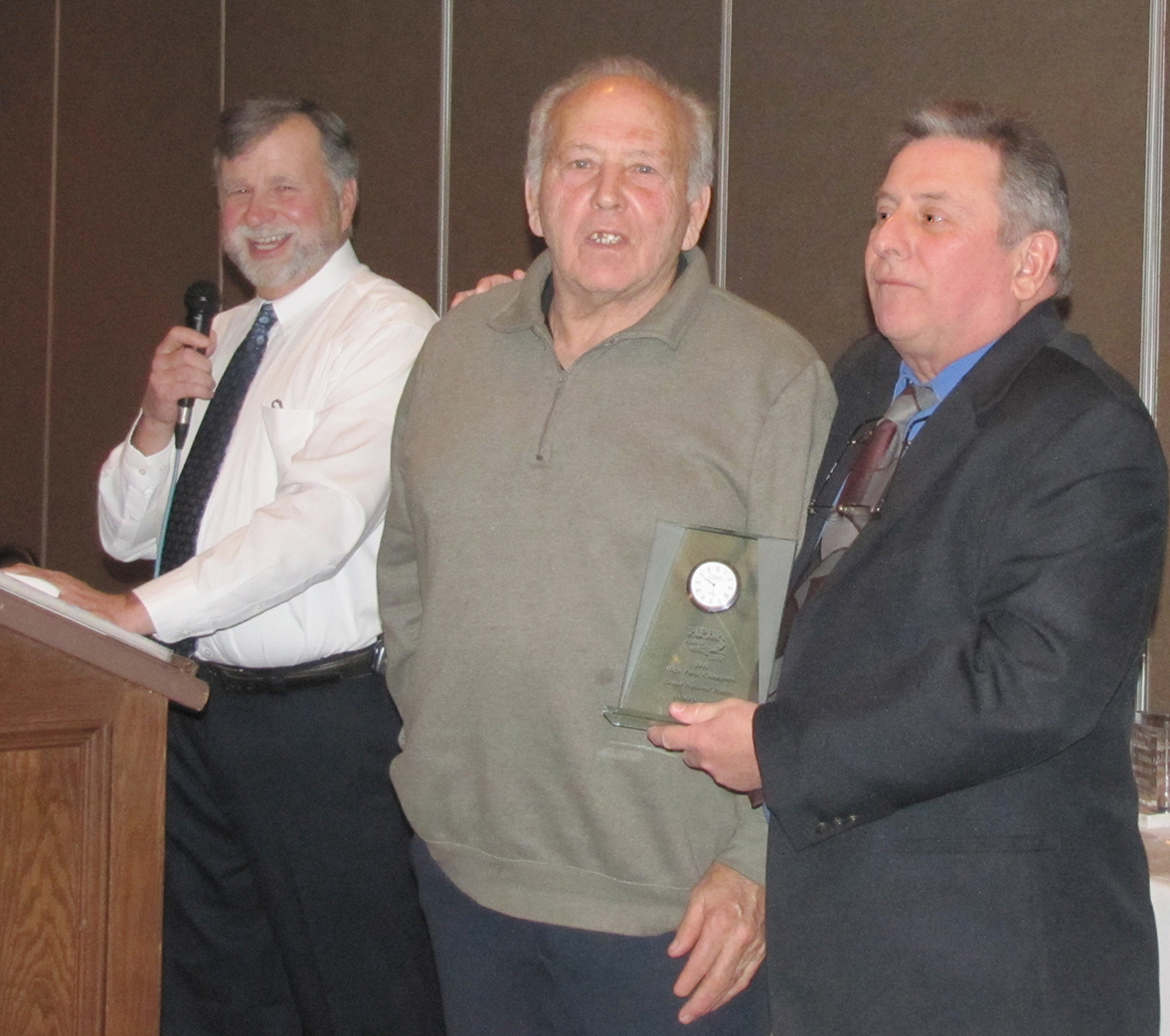
(L-R) The late, great Hall of Champions founder Fred Miller, manytime honoree Dave Villwock, and then-APBA President, the late Mark Wheeler, at the 2011 APBA Hall of Champions. APBA photo
When asked how he began racing, Villwock answers with a laugh, “Quite by accident.” His uncle Al raced Inboard hydroplanes. “He had a 135 and then a 225. The 135 was a Sooy hull if I remember right, and then he built a Ron Jones boat (the 225) off plans. When my cousin Craig and I got old enough, we decided to get a Crackerbox. That way we could build kits and drive. If you got a waiver, you could drive. So, we went and got a Crackerbox. Then we could all ride in it.”
Dave and Craig were about to start building a second boat when a famous Crackerbox, Lemon Crate, went up for sale. At about the same time, Dave’s brother Gary suffered a knee injury in a motorcycle race. Gary’s doctor told him to quit bike racing. If he injured his knee again, he would have to get an artificial knee.
“Back then they didn’t have artificial knees that flexed,” Villwock explains. “You could choose to have it straight or bent. They’d fuse it together that way.” Gary asked Dave about boat racing. “I said, ‘There’s a great boat for sale, but we couldn’t afford it.’ He goes, ‘How do you know? Have you asked?’ I said, ‘You’ve got a point.’ I’d seen it; it was a cool boat. I called Art Field, who owned it. He was a fairly well-to-do guy. I said, ‘I saw you have your boat up for sale. My brother Gary was racing bikes and he wanted to race boats with me and we thought that might be something fun to do. What are you asking for it?’ and he goes, ‘How much can you afford?’ I said, ‘We added up everything, and we’ve got $4,000 for the complete boat, motor, and trailer.’ The motor was by Paul Grichar, an engine builder from southern California, one of our heroes.” Field conferred with his wife, and they agreed to the $4,000 offer.
“We loaded up the old Ford truck. Four of us got in to drive to southern California to pick it up. We didn’t know it had two extra sets of headers, two extra seats. There were, like, four years’ worth of gaskets and stuff for the motor. We got the boat, brought it up here, and ran it. We won a bunch of races with a bunch of old motors.”
A race at Green Lake, in Seattle, was coming up, so the Grichar engine was installed in the boat. “We ran it, but it didn’t run very well,” Villwock admits. Paul Grichar was in the pits and Villwock went to talk with him. “I said, ‘Mr. Grichar, we’re running your motor in that boat and it’s not running any better than our junk. No disrespect, but I must be doing something wrong.’ He goes, ‘Well, how’d you adjust the valves?’ I said, ‘We brought both valves up, maybe a little bit even, adjusted both of them.’ ‘No, you have to adjust the exhaust when the intake is loose.’ I didn’t know that much background. He says, ‘Take your valve covers off. I’ll come down and take a look at it.’ There was a special camshaft that was better than anything we had, so we went through there, and he says, ‘You got all that?’ I said, ‘Yeah.’ He goes, ‘Okay, do it.’ He stayed there and said, ‘Okay, now you’ve got it.’ It ran a lot better, so we ran it that year. We won a couple championships with that.”
Dave Villwock and Jim Appley at the 2010 APBA National Meeting. Ray Dong photo

Villwock was developing friendships with top racers. “I was getting taught by guys like Glen Davis and Lynn Montgomery. They were mentors, taking me along to dyno trips and stuff like that. Then I sold the Crackerbox. Steve Jones, the guy that designed the Starfires, called me up. ‘I got this special boat over here; I’d like to have you run it.’ We became friends and he was a real mentor. He’s a brilliant guy. We went along with that and won a lot of races and set records, driving Super Stock, Pro Stock, SK, and Pro Comp—all of those classes. I got a lot of experience. I’d drive four classes a day. Somebody said, ‘Hey, you’re making great starts.’ I said, ‘Well, you’d think I could; I’ve been out there all day.’ They didn’t have adjustable plates in those boats. Steve didn’t believe in them. He said, ‘You give a guy an adjustable plate, he’ll slow the boat down. I just won’t give him one.’ You had to read the water and adjust before you got out there. I thought that was a good lesson.”
Villwock tells a story about a Divisionals race in Clarkston, Washington. “All the guys from southern California had come up. I’d made a start and I was passing this guy, and then I just about crashed. I passed him again and just about crashed, and passed him again at the finish and won the heat. Came in saying, ‘That was hard, those guys got powerful motors in those things.’ He goes, ‘If I ask you to race a heat like I tell you to, would you do it?’ I said, ‘Sure, whatever you say.’ ‘What I want you to do is pull up alongside that guy but don’t pass him. Make a start with him, pull up alongside, but don’t pass him. Then, the last half-lap if you’re not ahead, do what you want. But just run two and a half laps but don’t pass that guy.’ I went, ‘Mmm, okay.’ Seemed to me you wanted to get out front and finish off the race. Be the most aggressive at the front. As it turned out, I pulled up alongside that guy, ran two and a half laps, and then the guy overdrove the boat and went away. I drove around to see where he was. That was a lot easier. Sometimes, you don’t overdrive the boat. You put the boat in position and if you’re fast enough to stay there, then just stay there and let the other guy make mistakes.”

Dave Villwock, U-1 Miss Budweiser, holds the World Championship trophy at the 2004 Madison Regatta, Madison, Indiana, July 4, 2004. ©F. Peirce Williams
Before long, Villwock would move from flatbottoms to hydroplanes. “Jerry Yoder was a good friend of mine. We traveled to help George Woods race flatbottoms and hydroplanes across the country. Jerry said, ‘You’ve kind of done everything in the flatbottoms; why don’t we race hydroplanes?’ I’d driven them because I’d built motors for a lot of them, but I didn’t own one or race one. Back then, most everybody who owned something drove it. They didn’t have a driver and an owner. Most people worked on their own motors too. That’s changed some over the years, but that’s how it was back then. Jerry and I were helping George run the K boat and a 6-Litre at Dayton. The Pachanga crashed there, and we turned it into parts. Got most of the boat; the center boat was there and some other stuff. We set some records with the 6-Litre, and we’d done some things like the boats have now, with the extended rudder bracket and extended skid fin, and skid fins with different shapes than everybody else’s; stuff that we’d done that was pretty developmental.”
At about the same time, Villwock was working long hours at National Blower and Sheet Metal, a heating, ventilation, and air conditioning company in which his father was a business partner. “We were working lots of hours,” he says. “We were working on jobs, then we’d come home, we’d have a sandwich at the Dairy Queen next door, and then go back to work at, like, 5:00 until midnight, every night. We’d get up at 4:00 and do it again.” Villwock became skilled at making things. “You couldn’t buy a pipe rack; you had to build it. You couldn’t letter up a truck; you had to paint it. You couldn’t buy benches and stuff at a sheet metal shop; you had to build them.”
Villwock also became acquainted with Ron Jones. “He had kind of taken me under his wing and I’d fabricated a few things for them. They couldn’t figure out how to control the angle for the Unlimited mold. ‘Just come to the shop, I’ll roll you a piece of angle 30 feet long. I guarantee it won’t go anywhere.’ We had a big roll down at National Blower and Sheet Metal; we rolled one to the curve of the deck.”
Villwock raced across the country, and one person who was aware of his developmental work and driving ability was John Prevost. When Prevost was driving the Miss Circus Circus Unlimited hydroplane, based in Las Vegas, he reached out to Villwock for help. “He called me up and said, ‘Hey, would you come down? We want to put on a skid fin like on your boat, and a rudder bracket like on your boat, and we need to build a canopy. Would you come down and do that?’ I said, ‘Naw.’ One thing I’d learned from George Henley: he told me how much he loved racing boats, but it damn near broke him. I sat in the Miss Tide Air back when I was about eight years old. I had respect for that. I thought, you know, he’s right. I can race limited boats, I can fly model airplanes, I can run sheet metal shops. Life’s pretty good if I don’t screw it up dreaming about what’s possible, so I’ll just stay with that. When Prevost asked me to come down and do that, I said, ‘I’m trying to stay away from that. Life’s okay if I don’t screw it up. I’m working all day and I really don’t have the time to go do that.’ He goes, ‘Okay, I appreciate it, thanks.’ About two days later he calls back. He said, ‘Some of the guys that work on your crew, do they work on that stuff? Do you have anybody there that could come down and help us?’ I said, ‘Yeah, Paul Casura. He did a little work.’ So I called Paul, ‘Hey, do you want to go down there?’ He goes, ‘Yeah.’ So I put them together and he went down there.”
A few days later Villwock received a telephone call from Paul Casura. “He goes, ‘Aw, Dave, this is way bigger than anything we did. Can you come down and help me with this?’ Well, I could say no to them, but I couldn’t say no to Paul. So I went down there, and that process was what hooked me into getting started with this (gestures toward the Unlimited pit area). The guy who was working on their canopy quit, so now I’m more involved with that too. Meanwhile, they were setting some things up on the boat, and I thought, ‘This isn’t going to work. This thing’s gonna crash.’ But, I didn’t really care at that time, I was just doing work. Chip Hanauer walked in and said hi. (Hanauer was slated to drive Miller American – Ed.) I worked for a while and asked, ‘Are you going to get in and drive this boat?’ He said, ‘If Prevost isn’t in town or for some other reason, yeah, I’ll take it out and qualify it or something.’ I said, ‘Don’t get in it; it’s going to crash,’ due to how they’d set some of the things up. Of course, you can imagine the team responding, ‘Oh, you don’t understand these boats.’ ‘You’re right, I know nothing. I just felt the responsibility to tell somebody that I think there’s a problem. If there’s not, great. I’m not going to be in there racing, so I’m good.’ Well, they go down to San Diego and they both blow over. Then Chip calls. ‘Obviously, you know more about these things than we do. Would you come?’ I went, ‘No, I think it’s a bad idea. Stay away from that.’”

Chip Hanauer, U-100 Miss Pico (L) talks with his former Miss Circus Circus crew chief Dave Villwock, now the driver of the U-1 Miss Budweiser. Lake Havasu Hydrofest 1999, Lake Havasu City, AZ, May 1999. ©F. Peirce Williams
Villwock soon received another request from the Circus Circus team. “I get a call at about 8:00 at night and it’s Bill Bennett (owner of the Circus Circus casinos). He says, ‘I understand you don’t want to work for us.’ I said, ‘That’s right.’ He says, ‘Do you mind if I ask you why?’ I said, ‘My overview is that boats are over-expected and under-funded for that end. I fly model airplanes, you know, and do other things, race limited boats at the Budweiser level, and life’s okay.’ He goes, ‘I can understand that.’ I asked, ‘What can I do for you?’ ‘Just go down and look around my shop. Tell me what I need to do. I’ll send a plane up for you. Come down here and tell me what I need to do.’ So, I go down to the shop and I look around. I take a few notes. Went in his office and told him, ‘You have one boat broken in two, one boat that’s barely competitive. You have, like, five motors, only one-half of one is any good. I don’t really know that much about them, but that’s what they’re telling me. I believe them by looking at the parts. You don’t have any propeller program. They tell me they’re spending a lot to get one heat of racing from a Mercury propeller, and that doesn’t make a lot of sense. So, you need to do all that stuff.’ He says, ‘Okay, anything down here you want to do? When do you want to go home?’ Private plane, ‘I suppose whenever the plane leaves.’ He goes, ‘Oh, that can leave any time you want it to, but we’re going to go out and fly some model airplanes. I have a ranch out here and a caretaker and a guy that builds airplanes for me. We go out and fly every Saturday. Love to have you out there, we’ve got plenty of airplanes.’ So, we go out and fly airplanes, but he doesn’t say anything about the boat all day. Then he says, ‘I’m getting a little tired, I think I’ll head home. Donnie will take you down to the hangar.’ I’ said, Thanks, and I appreciate you spending some time with me.’ He says, ‘That’s great, yeah, me too.’ He got in the car and came back by, rolled down his window and said, ‘You know, I kind of like you. You ought to reconsider that offer I made you.’ I thought about it and said, ‘I always said I wouldn’t do it if it wasn’t done right. What if I put together a program and we could do it right?’ I gave it 24 hours and I called him back. I said, ‘I thought about it. Maybe you’d like me to put together a program of what it’s going to take to get you from where you’re broken and no good and not competitive, to beating the Budweiser boats.’ He goes, ‘You know, I’ve been trying to get somebody to do that for two years. Let’s do that. Put whatever you need in there for it.’ We talked a little bit and I came back and put the rest of the program together. I called him up and said, ‘Do you want me to mail this in?’ There was no internet back then. He goes, ‘You got a fax machine?’ ‘Yeah.’ ‘Here, I’ll give you the number.’
“I kind of inflated my wages and some other things, thinking we were going to be in negotiation with this, and I’m trying to figure out how to land on my feet after I get fired—because I probably will, I’ve never done anything with these things. All this could go bad. I send the whole package over and he calls me, like, three minutes later and says, ‘We got a deal. When can you go to work?’ I guess I’m in Unlimited racing now. That’s how I got there.”

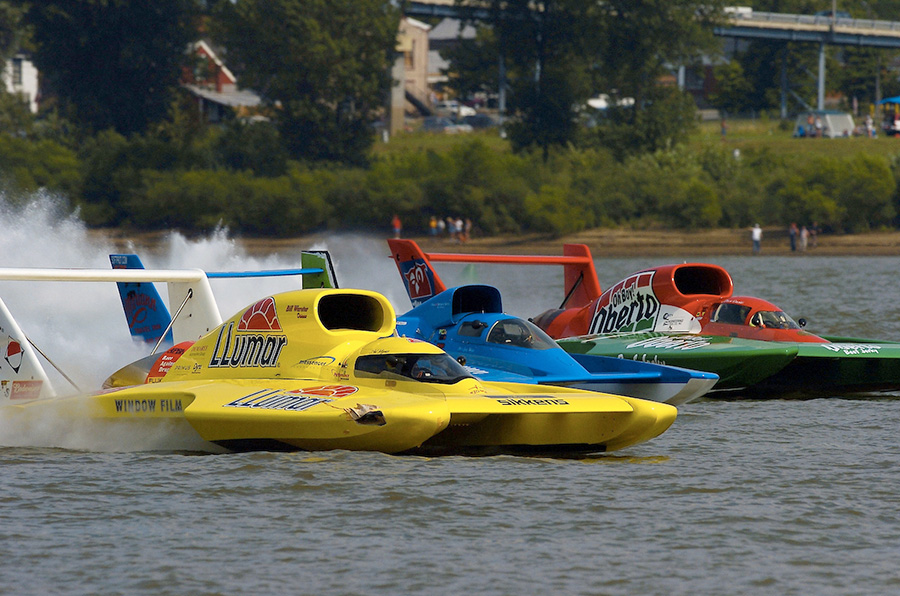
Cockpit to cockpit as they race to the start, (front to back): Brian Perkins, U-21 Miss Gill Chiropractic, Steve David, U-1 Oh Boy! Oberto, and David Villwock, U-96 Spirit of Qatar. APBA Gold Cup, Detroit, MI, July, 2010. ©F. Peirce Williams
Looking back at his years in Inboard racing, Villwock recalls some of his favorite courses. “We liked Black Lake, Green Lake, and Lake Lawrence.” He won the 1975 Crackerbox Nationals on Green Lake, in Seattle. “Green Lake was a special place, and St. Petersburg. Those were the main hubs for everybody who was anybody in Limited racing. If you did okay there, you were somebody.”
He also holds special memories of his friend and sponsor Jerry Yoder. “He owned half of Sunset Chev through hard work,” Villwock remembers. “He was a lot boy there when he started. They lived next door. Worked himself up to the top truck salesman. He worked everywhere in the company, and he ended up owning it.”

Villwock in Jerry Yoder’s 6-Litre Sunset Chevy.
One time, Yoder loaned a van to Bud Cleary so he could tow boats to Haag Lake. “Everything went fine at the race; we had the record,” Villwock says. “Then we came back and Jerry says, ‘The outboard on my Glastron needs a little work. Think you can be involved in figuring out how to fix that?’ I went, ‘Absolutely.’ We grabbed his boat and Paul fixed his motor. Then when Paul brought it back he said, ‘You know what we ought to do? We ought to spend another day here. Nobody ever does anything for Jerry. He always does everything for everybody else. We’ll fix the carpet in it, wax and polish it, then take it to Jerry.’ So, we did all that. We got Jerry in tears. Nobody ever did anything for him. So, that rolls over into the hydroplane. Just do one thing right; it pays off.”

1996 APBA Gold Cup, Detroit, MI: Dave Villwock checks the prop he would use to win his first Gold Cup with U-100 Pico American Dream. © F. Peirce Williams

Dave Villwock and the U-1 Miss Budweiser at the 2004 Madison Regatta, Madison, Indiana, July 4, 2004. ©F. Peirce Williams
Now, at age 71, Villwock is still racing. He currently drives the Miss Apollo Unlimited. He is the oldest person to drive an Unlimited and win. He has spent a lifetime doing what he loves; he has fond memories and great stories about the path his career has taken. Some of it was luck and perseverance, but most of it was the result of his talent, focus, and unrelenting commitment.

…And the winner of the 100th APBA Gold Cup was Dave Villwock, July 2009, on the Detroit River, Detroit, MI. ©F. Peirce Williams
Featured Articles